


 95 km
 IPs compared
 Last compared on
 Providers compared
 % Disputed

 MaxMind
 IP2Location
 BigDataCloud
 ipapi.is
 MaxMind
 BigDataCloud
 IP2Location
 DB-IP
 BigDataCloud
The field everything depends on
Accurate pricing, local forms, and tax checkouts all rely on getting the country right.



When the country is wrong, region, city and time zone can go wrong with it, and so can localization and analytics.
Registry records say one country; the network sometimes says another. We verify IP geolocation with ping, traceroute and BGP data, and show where other providers get it wrong.
Speed of light check
1 of 4: 170.81.135.1, measured in the United States
 170.81.135.1
Brazil ruled out
In 1.23 ms, light in fiber only gets about 123 km from Dallas and back.
IPGeolocation.io
United States
IPs from today's measurements where at least four IP data providers named a different country and our active measurement proved ours right. Each row shows what we measured, what they returned and the network evidence behind the call.
| IP addressNetwork | IPGeolocation.ioMeasured country | Other providersCountries returned | EvidenceClosest vantage point |
|---|---|---|---|
209.127.158.20BusinessIPv4 |  GermanyConfirmed | United States ×42 agree with IPGeolocation.io | 0.8 ms from Frankfurtwithin 80 km |
Physical latency constraint United States ruled out Light in fiber covers about 200 km per ms, so a 0.8 ms round trip keeps the IP within 80 km. United States is 6,964 km away.
| |||
82.47.0.127HostingIPv4 |  FranceConfirmed |  United Kingdom ×34 agree with IPGeolocation.io | 1.09 ms from Pariswithin 109 km |
Physical latency constraint United Kingdom ruled out Light in fiber covers about 200 km per ms, so a 1.09 ms round trip keeps the IP within 109 km. United Kingdom is 337 km away.
| |||
80.84.173.0BusinessIPv4 |  SwedenConfirmed | United Kingdom ×53 agree with IPGeolocation.io | 0.5 ms from Stockholmwithin 50 km |
Physical latency constraint United Kingdom ruled out Light in fiber covers about 200 km per ms, so a 0.5 ms round trip keeps the IP within 50 km. United Kingdom is 1,433 km away.
| |||
45.199.248.123HostingIPv4 |  RussiaConfirmed |  Belarus ×71 agrees with IPGeolocation.io | 1.52 ms from Moscowwithin 152 km |
Physical latency constraint Belarus ruled out Light in fiber covers about 200 km per ms, so a 1.52 ms round trip keeps the IP within 152 km. Belarus is 669 km away.
| |||
63.218.242.141ISPIPv4 | United KingdomConfirmed |  Hong Kong ×24 agree with IPGeolocation.io | 1.05 ms from Londonwithin 105 km |
Physical latency constraint Hong Kong ruled out Light in fiber covers about 200 km per ms, so a 1.05 ms round trip keeps the IP within 105 km. Hong Kong is 9,624 km away.
| |||
91.90.124.140HostingIPv4 |  IrelandConfirmed |  Isle of Man ×62 agree with IPGeolocation.io | 0.34 ms from Dublinwithin 34 km |
Physical latency constraint Isle of Man ruled out Light in fiber covers about 200 km per ms, so a 0.34 ms round trip keeps the IP within 34 km. Isle of Man is 145 km away.
| |||
185.99.186.187ISPIPv4 |  SpainConfirmed |  Netherlands ×35 agree with IPGeolocation.io | 1.46 ms from Madridwithin 146 km |
Physical latency constraint Netherlands ruled out Light in fiber covers about 200 km per ms, so a 1.46 ms round trip keeps the IP within 146 km. Netherlands is 1,481 km away.
| |||
78.47.153.231HostingIPv4 |  FinlandConfirmed | Germany ×90 agree with IPGeolocation.io | 0.3 ms from Helsinkiwithin 30 km |
Physical latency constraint Germany ruled out Light in fiber covers about 200 km per ms, so a 0.3 ms round trip keeps the IP within 30 km. Germany is 1,318 km away.
| |||
108.156.64.127HostingIPv4 | NetherlandsConfirmed | United States ×33 agree with IPGeolocation.io | 0.63 ms from Amsterdamwithin 63 km |
Physical latency constraint United States ruled out Light in fiber covers about 200 km per ms, so a 0.63 ms round trip keeps the IP within 63 km. United States is 5,862 km away.
| |||
54.37.140.88HostingIPv4 |  PolandConfirmed | France ×24 agree with IPGeolocation.io | 0.71 ms from Warsawwithin 71 km |
Physical latency constraint France ruled out Light in fiber covers about 200 km per ms, so a 0.71 ms round trip keeps the IP within 71 km. France is 1,244 km away.
| |||
185.160.45.109HostingIPv4 |  GreeceConfirmed |  India ×71 agrees with IPGeolocation.io | 1.69 ms from Athenswithin 169 km |
Physical latency constraint India ruled out Light in fiber covers about 200 km per ms, so a 1.69 ms round trip keeps the IP within 169 km. India is 5,170 km away.
| |||
185.237.106.86BusinessIPv4 |  UkraineConfirmed | United States ×23 agree with IPGeolocation.io | 0.46 ms from Kyivwithin 46 km |
Physical latency constraint United States ruled out Light in fiber covers about 200 km per ms, so a 0.46 ms round trip keeps the IP within 46 km. United States is 7,511 km away.
| |||
185.186.52.11BusinessIPv4 | GermanyConfirmed |  United Arab Emirates ×62 agree with IPGeolocation.io | 0.4 ms from Nurembergwithin 40 km |
Physical latency constraint United Arab Emirates ruled out Light in fiber covers about 200 km per ms, so a 0.4 ms round trip keeps the IP within 40 km. United Arab Emirates is 4,648 km away.
| |||
149.6.36.68ISPIPv4 | FranceConfirmed | United States ×34 agree with IPGeolocation.io | 1.21 ms from Marseillewithin 121 km |
Physical latency constraint United States ruled out Light in fiber covers about 200 km per ms, so a 1.21 ms round trip keeps the IP within 121 km. United States is 6,632 km away.
| |||
136.23.55.153HostingIPv4 | SwedenConfirmed |  Norway ×60 agree with IPGeolocation.io | 0.66 ms from Stockholmwithin 66 km |
Physical latency constraint Norway ruled out Light in fiber covers about 200 km per ms, so a 0.66 ms round trip keeps the IP within 66 km. Norway is 399 km away.
| |||
Showing 15 of 277
Accurate pricing, local forms, and tax checkouts all rely on getting the country right.
When the country is wrong, region, city and time zone can go wrong with it, and so can localization and analytics.
A ping crosses fiber at about 200 km per millisecond and has to come back, so each millisecond of round trip allows at most 100 km.
If the circle stays inside one country, physics settles the country. If it crosses a border, one ping isn't enough: traceroute paths, BGP routing data and pings from other servers fill the gap.
When evaluating raw IP data, you must always start by checking the country field.
If an IP is in the wrong country, the fields that depend on it can be wrong too, which makes country errors the quickest way to spot weak data.
IP geolocation accuracy starts with the country. City-level location, region, time zone, currency, calling code and language all build on it, and so do tax, compliance and content-licensing rules. A wrong country can make every one of them wrong too.
It's also the quickest field to check from the outside, which makes it the clearest one to show here.
 Everything lines up
See accurate location data in real time with our APIs.

No credit card required
Every IP in today's list was measured by our Vantage Network rather than taken from registry records. Each measurement leaves evidence you can read: how fast the IP answered, which path the packets took and which network announces the address.
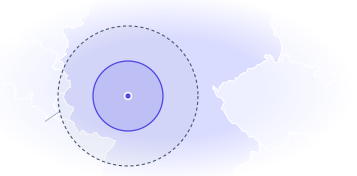
Measurement points around the world send probes and time every reply. Light in fiber covers about 200 km per millisecond, so each round trip draws a circle the IP cannot sit outside.
Ping the IP from Frankfurt:0.6 ms → within 60 kmTraceroutes reveal the network path and last known hop leading to the IP.
BGP routing data shows which network currently announces the IP's prefix.
A location is confirmed when the measurements agree on it, for the country and for the city.
Multilateration times one IP from many of our servers and finds the one place every answer agrees on. It's one of the layers in how our IP geolocation data is built.
A ping's round trip caps how far away the IP can be. Light in fiber covers about 200 km per millisecond, so a 1 ms round trip puts the IP within 100 km of the server.
The server sits at its center, and the IP is somewhere inside it.
Circles from different directions cut the area down to the part they all share.
Servers hundreds of kilometers away can only narrow the IP to a region. Servers tens of kilometers away narrow it to a city.
Narrowed to 11 km
Country errors come from trusting paperwork over the network. These are the four patterns behind them.
The examples here are country level because that's where an error is plainest to see. All of our location data, city level included, runs through the same measurement pipeline.
A few IPs where providers report different countries than our measurement.
 ZAUS
 CO
Real IPs from today's list above.
We check where each IP data provider says the IP is located, and compare it to our measurement.
USZAMismatchZAZAMatch JPZAMismatch
Each row stands on its own. We're looking for differences, not counting how often providers make them.
These IPs show where at least four IP data providers reported a different country than our measurement.
Every day we check what other providers return for the same IPs.
Each row lists what each IP data provider returned for the IP, by name, next to our measurement.
USDiffers from our measurementZAMatches our measurementJPDiffers from our measurementZAEach row stands on its own: our measurement of the IP, next to what each provider returned.
Exclude IPs that do not answer probes.
Leave out anycast addresses and border-straddling results.
What's left are IPs our measurements place inside a single country.
Only rows with clear measurements make the list.
The user's traffic goes through a VPN server in another location.
The IP appears where the VPN server is, and that is the correct answer for the IP.
DEOur VPN, proxy and relay detection identifies anonymized connections and tells them apart from regular users.
We measure the IP again from our servers and compare.
If the location is incorrect, we review and update it.
Every location on this page comes from the data your app gets back. Put it behind fraud checks, localization and analytics, and start free with 1,000 credits a day.
No credit card required.
Get the latest in geolocation tech, straight to your inbox.
 Only Germany
 4 countries


 Time zone
 Currency
 Language




 New York
 America/New_York
 VPN Detected


 Data center IP

 Singapore
