



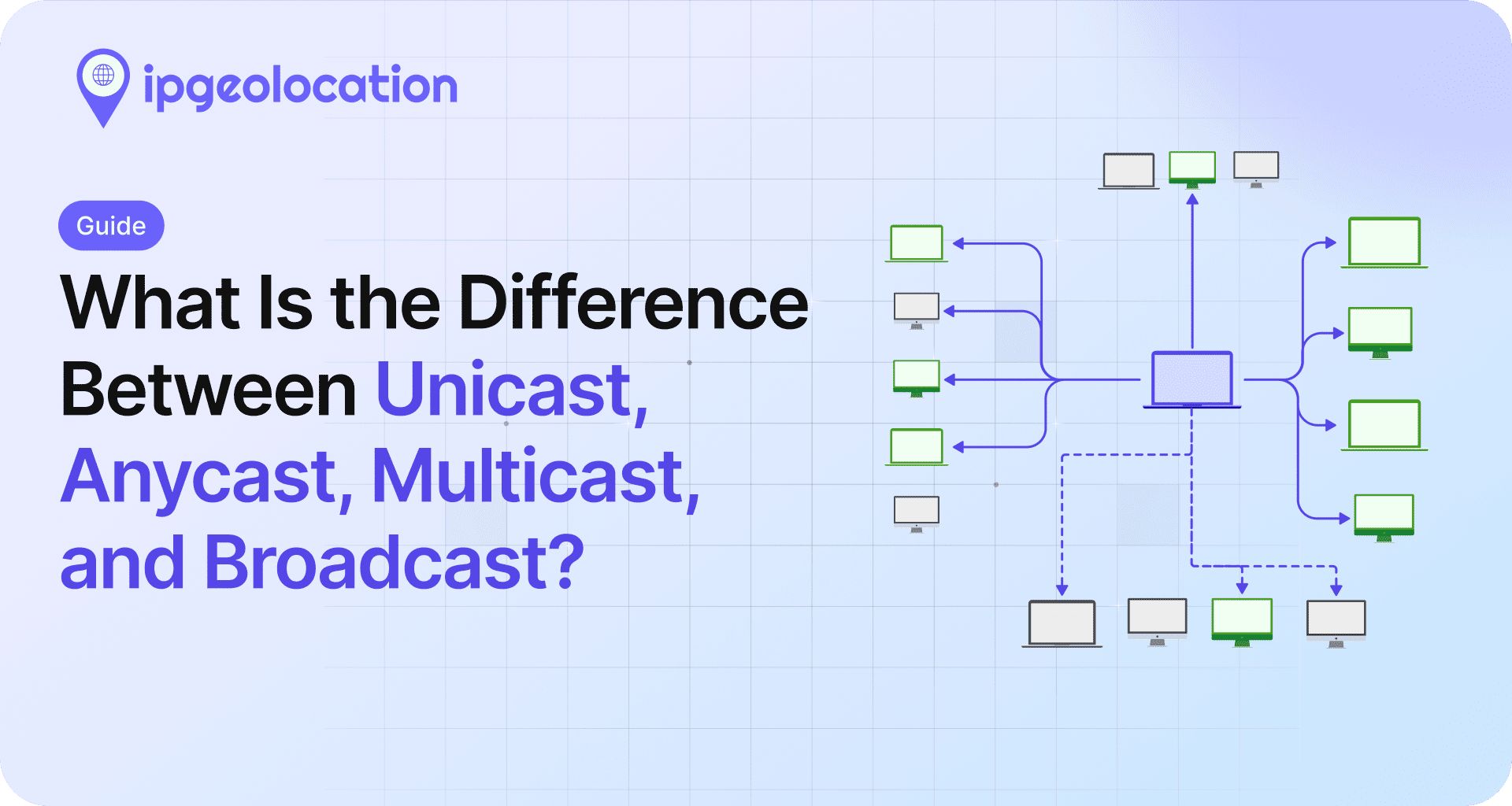
Unicast, multicast, broadcast, and anycast define how data travels from a sender to one or more receivers on a network. A video call between two people uses unicast. A live IPTV feed reaching thousands of subscribers at once uses multicast. An ARP request finding the right MAC address on a LAN uses broadcast. And when a device sends a DNS query to Google Public DNS at 8.8.8.8, anycast routes that query to whichever server is topologically closest.
Each method solves a different distribution problem, and picking the wrong one creates real performance and scalability issues. Understanding unicast vs multicast alone does not cover the full picture, because anycast and broadcast fill roles that neither one can. The sections below cover how each type works at the protocol level, where it fits, and what tradeoffs it brings.
TL;DR
- Unicast sends data from one sender to one specific receiver. It is the default for most internet traffic, including HTTP, email, and SSH.
- Broadcast sends data to every device on a local network segment. Used for discovery protocols like ARP and DHCP. Not supported in IPv6.
- Multicast sends data to a group of devices that have opted in. Efficient for one-to-many distribution like IPTV and live video.
- Anycast assigns the same IP address to servers in multiple locations. The network routes each request to the nearest one. Used heavily in DNS and CDN infrastructure.
The right choice depends on whether you need one-to-one reliability (unicast), group delivery efficiency (multicast), local discovery (broadcast), or geographic proximity routing (anycast).
What Is Unicast?
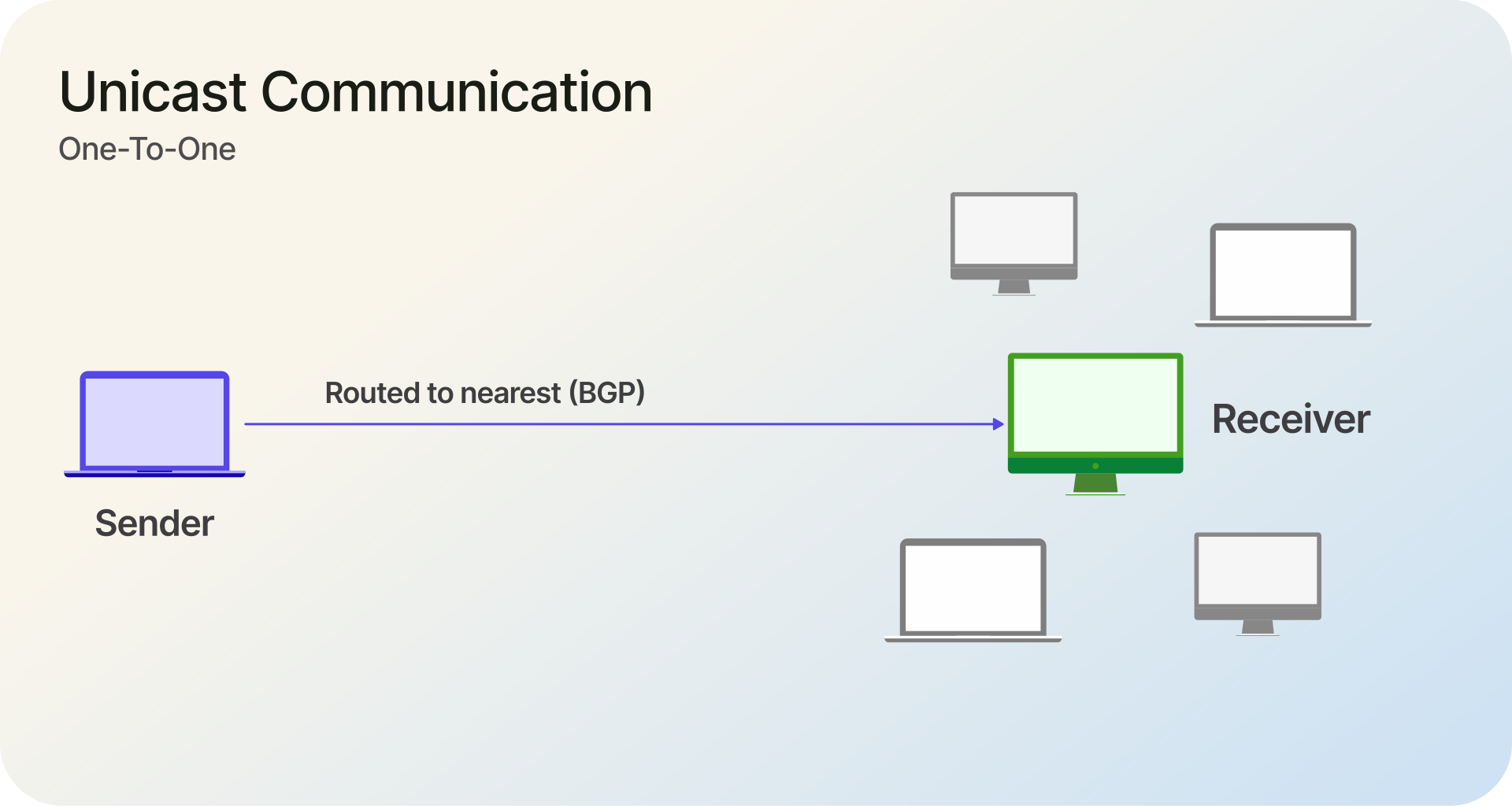
Unicast is one-to-one communication. A single sender transmits data to a single, specific receiver identified by a unique IP address. Every HTTP request you make, every email you send through SMTP, every file you download over FTP, and every SSH session you open is unicast traffic.
This is the default model for most internet communication. TCP, which carries the majority of internet traffic, is inherently unicast. It establishes a dedicated connection between two endpoints, guarantees packet ordering, and handles retransmission of lost packets. UDP also supports unicast for point-to-point use cases like VoIP calls and online gaming, where speed matters more than guaranteed delivery.
Any non-reserved unicast address can serve as the destination. There is no special address range. The sender knows exactly where the packet is going, and the network routes it there.
The limitation shows up at scale. If 1,000 users want to watch the same live stream, unicast requires 1,000 separate copies of that stream from the server. Each viewer gets their own data flow, which means bandwidth consumption scales linearly with audience size. Netflix operates this way, sending individual unicast streams to each subscriber over HTTPS, and they handle the bandwidth cost through massive CDN infrastructure.
1. Pros
- Simple to implement. No special network configuration needed.
- Reliable delivery when paired with TCP (acknowledgments, retransmission, ordering).
- Works across the entire internet without router-level support for special protocols.
- Easy to secure with encryption (TLS/SSL) on a per-connection basis.
2. Cons
- Bandwidth scales linearly with the number of receivers. Sending the same data to 1,000 users means 1,000 separate streams.
- Not efficient for one-to-many distribution like live video or real-time data feeds.
- Server load increases directly with connection count.
What Is Broadcast?
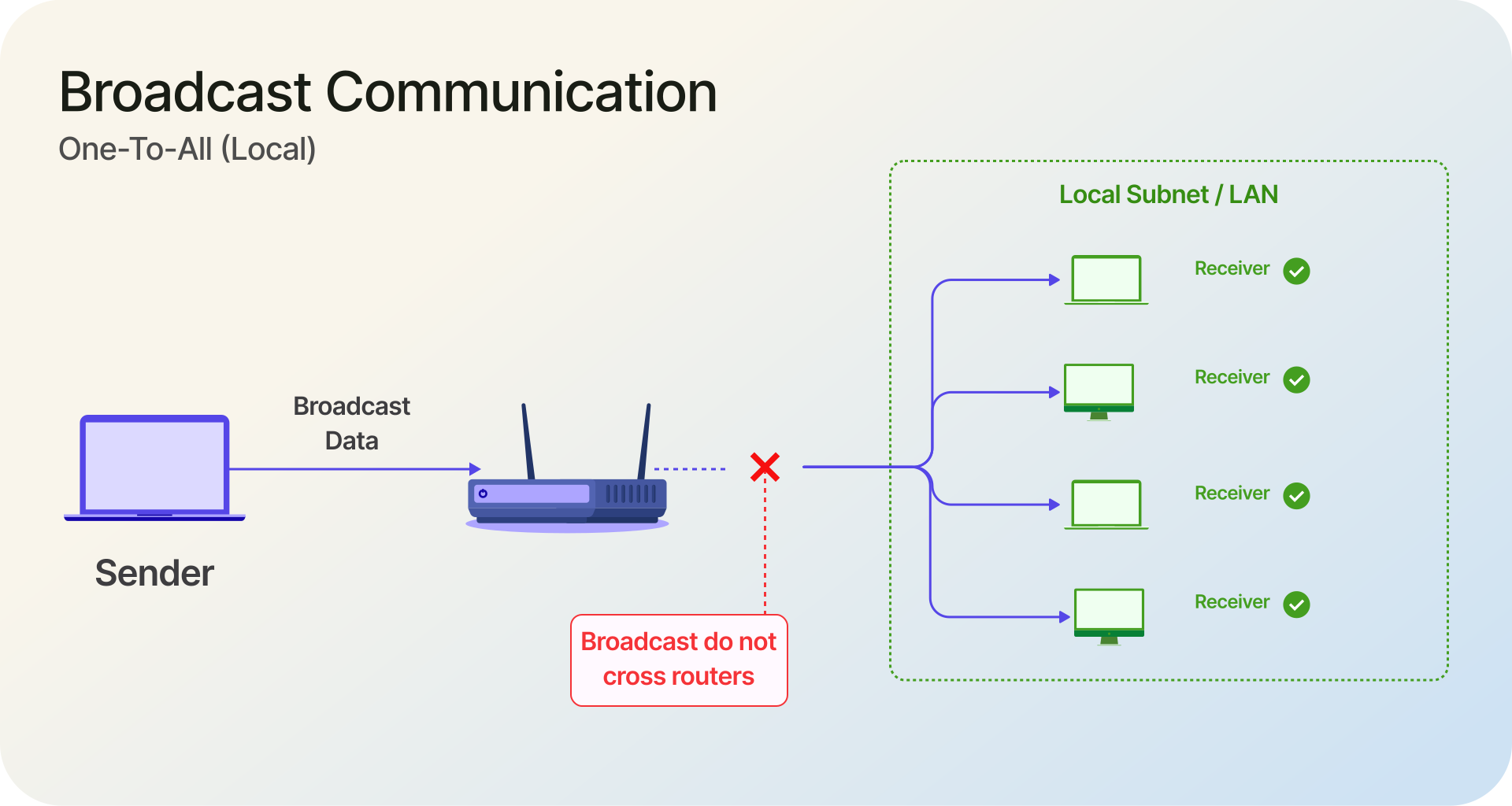
Broadcast sends a packet to every device on the same network segment. The sender does not target a specific host. Instead, it uses a special broadcast address, and every device on the subnet receives and processes the packet.
In IPv4, there are two broadcast address types. The limited broadcast address, 255.255.255.255, reaches all devices on the local network regardless of subnet. The directed broadcast address targets all hosts within a specific subnet. For a 192.168.1.0/24 network, the broadcast address is 192.168.1.255. Routers do not forward broadcast traffic by default, so broadcasts stay confined to the local Layer 2 domain.
Two of the most common protocols depend on broadcast. ARP (Address Resolution Protocol) broadcasts a request to find the MAC address associated with an IP address on the local network. DHCP uses broadcast during its discovery phase, when a client that has no IP address yet needs to find a DHCP server.
IPv6 eliminated broadcast entirely. RFC 4291, the IPv6 addressing architecture specification, replaced it with multicast. The all-nodes multicast address (ff02::1) serves a similar local-scope function without the inefficiency of hitting every device on the network unconditionally.
1. Pros
- Essential for network discovery. Protocols like ARP and DHCP cannot function without it.
- Simple to use. No group management or subscription mechanism needed.
- Fast for reaching all devices on a small LAN segment.
2. Cons
- Creates unnecessary traffic on large networks. Every device must process every broadcast frame, even if the data is irrelevant to it.
- Broadcast storms can degrade or crash network segments if misconfigured devices loop traffic.
- Does not cross routers. Limited to the local subnet.
- Completely removed from IPv6, meaning it is a legacy mechanism with a shrinking role.
What Is Multicast?
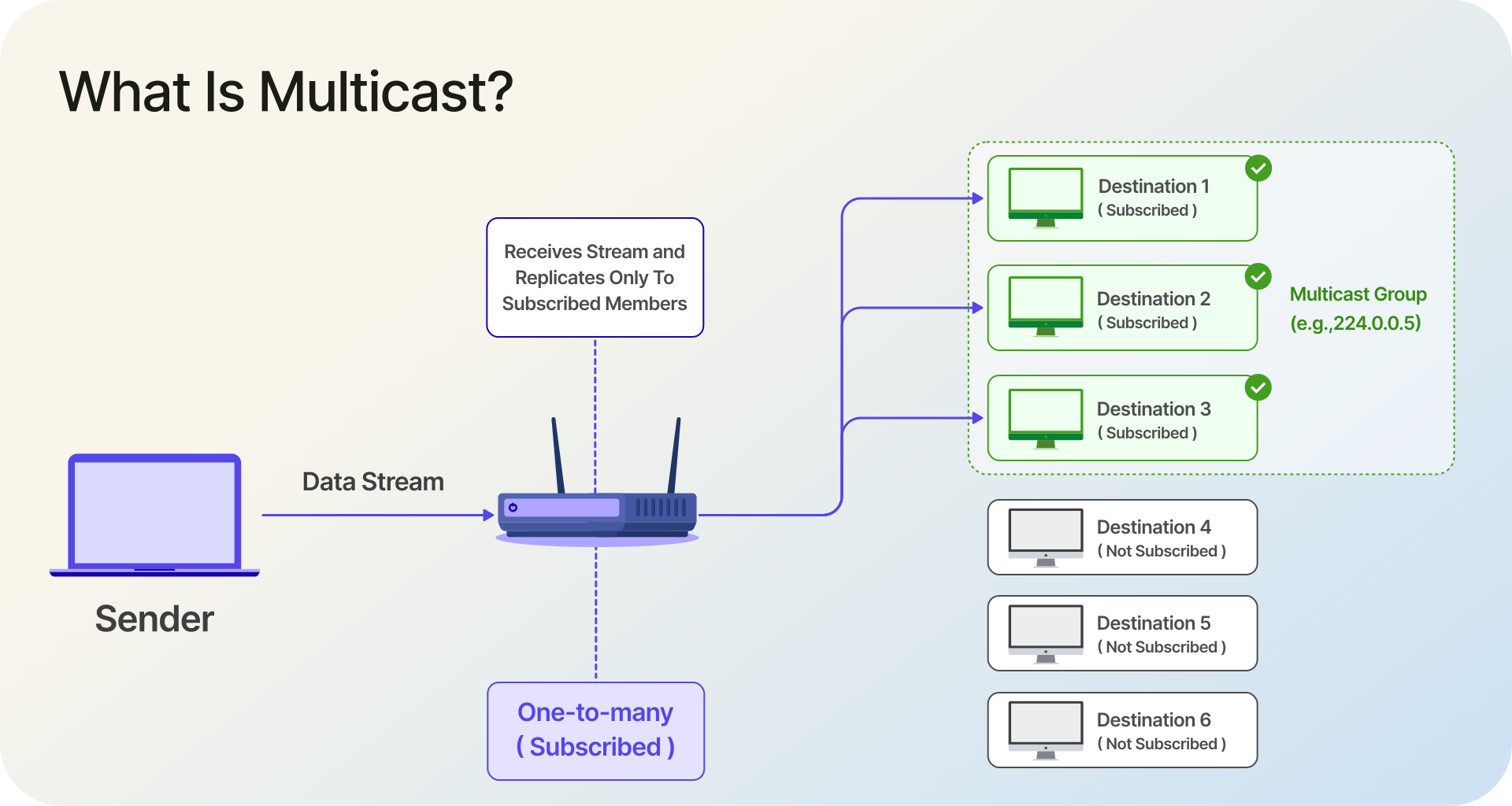
Multicast delivers data from one sender to a specific group of receivers that have opted in. Unlike broadcast, which forces every device to process the traffic, multicast only reaches devices that have subscribed to a particular multicast group.
The process works through group management protocols. On IPv4 networks, hosts use IGMP (Internet Group Management Protocol) to join or leave multicast groups. IPv6 uses MLD (Multicast Listener Discovery) for the same purpose. At the router level, PIM (Protocol Independent Multicast) builds efficient distribution trees so traffic replicates only at branch points in the network where subscribers actually exist.
IPv4 reserves the address range 224.0.0.0 through 239.255.255.255 for multicast, as documented in the IANA IPv4 Multicast Address Space Registry. This is the Class D address space. In IPv6, multicast addresses use the ff00::/8 prefix, covering addresses from ff00:: through ffff:ffff:ffff:ffff:ffff:ffff:ffff:ffff.
IPTV is the textbook multicast use case. A television provider sends one copy of each channel's stream into the network. Routers replicate that stream only toward subscribers who have joined the channel's multicast group. Serving 10,000 viewers of the same channel costs roughly the same bandwidth at the source as serving 10, because the replication happens in the network, not at the origin server. OSPF, the routing protocol, also uses multicast (224.0.0.5 and 224.0.0.6) for router-to-router hello messages.
1. Pros
- Highly bandwidth-efficient for one-to-many delivery. One stream serves thousands of subscribers.
- Receivers control their own subscription. Devices join or leave groups as needed.
- Scales well for live distribution (IPTV, video conferencing, stock market data feeds).
2. Cons
- Requires multicast-enabled infrastructure. Routers and switches must support IGMP snooping, PIM, and multicast routing.
- More complex to configure and troubleshoot than unicast.
- Uses UDP, so there is no built-in delivery guarantee, packet ordering, or retransmission. Applications must handle reliability at a higher layer if needed.
- Limited internet-wide support. Most ISPs do not pass multicast traffic between networks, confining it to enterprise and managed service provider environments.
What Is Anycast?
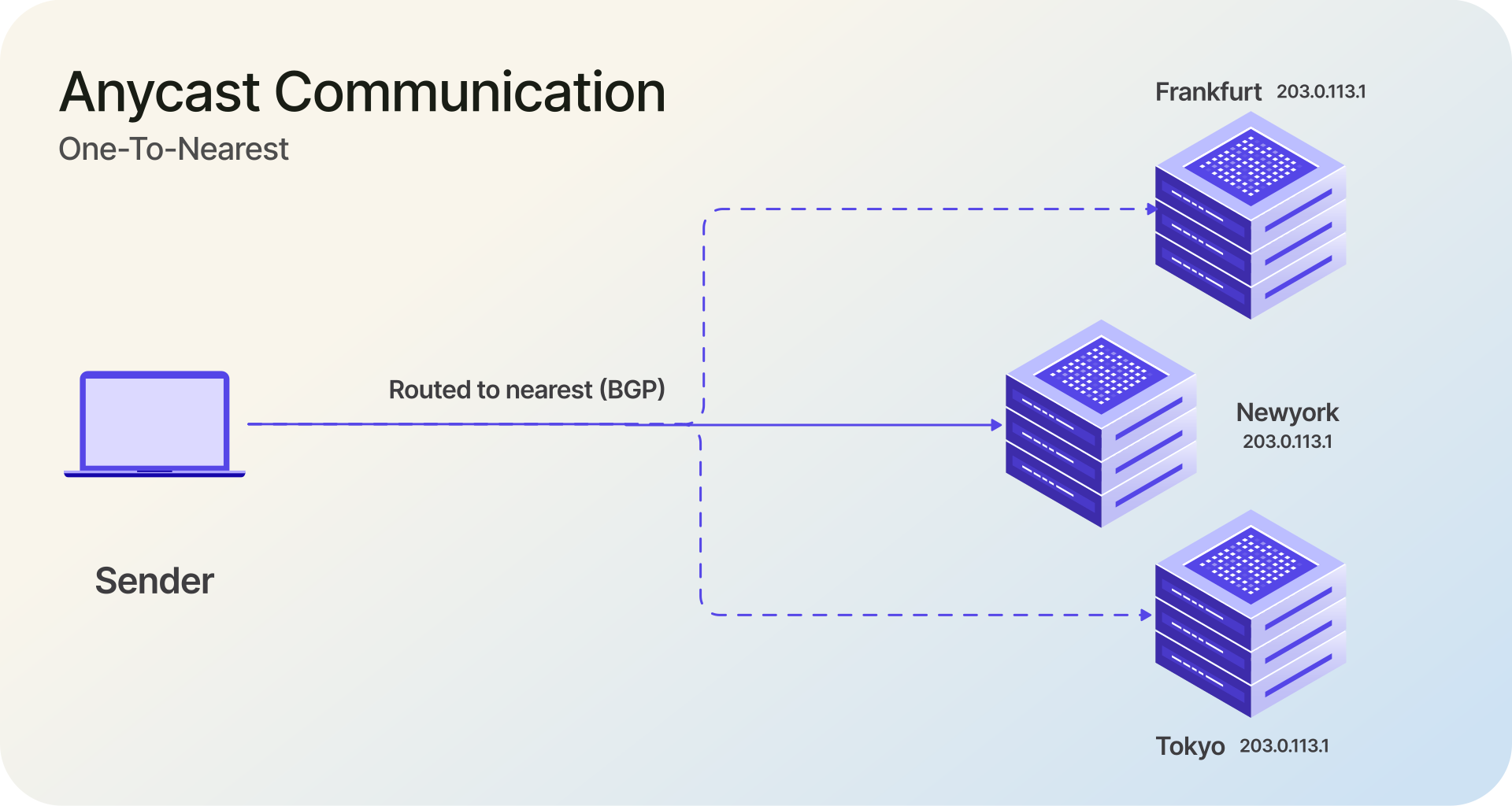
Anycast assigns the same IP address to multiple servers in different geographic locations. When a client sends a packet to that address, the network routes it to the nearest available instance based on BGP (Border Gateway Protocol) path selection. The client has no idea that other servers sharing the same address exist.
The concept was formally proposed in RFC 1546 in 1993. Unlike multicast, which delivers packets to all group members, anycast delivers each packet to exactly one destination: the topologically closest node. BGP makes this work by advertising the same IP prefix from multiple autonomous systems or PoPs (Points of Presence). Routers select the shortest AS path, and traffic naturally flows to the nearest server.
Google's public DNS at 8.8.8.8 is one of the most recognized anycast deployments. That single IP address is served from data centers across dozens of countries. A DNS query from Tokyo reaches a Google server in Asia, while the same query from Berlin reaches one in Europe. Cloudflare's 1.1.1.1 works the same way. The root DNS server system, which handles the foundation of the global domain name system, also uses anycast across 13 named authorities operating from over 1,900 instances worldwide.
Anycast provides natural DDoS resilience. Because traffic distributes across many locations, a volumetric attack against an anycast address gets absorbed across the entire network rather than overwhelming a single server. If one node goes offline, BGP withdraws its route announcement, and traffic reroutes to the next closest node automatically.
The tradeoff is statefulness. Because network path changes can shift which server handles a client's packets, anycast works best for stateless protocols. DNS over UDP is the ideal case: each query is independent. Using anycast for long-lived TCP connections requires additional engineering, such as ECMP (Equal-Cost Multi-Path) hashing or connection tracking at each node, to prevent mid-session rerouting from breaking the connection.
1. Pros
- Reduces latency by routing users to the nearest server automatically.
- Built-in failover. If a node goes down, BGP reroutes traffic to the next closest location with no client-side changes.
- Strong DDoS mitigation. Attack traffic distributes across all anycast nodes instead of concentrating on one target.
- No client-side configuration needed. The client just sends to a single IP address.
2. Cons
- Not ideal for stateful TCP connections without additional engineering (connection pinning, ECMP hashing).
- Requires BGP control across multiple locations, which means significant infrastructure investment.
- Debugging and monitoring are harder because the same IP maps to different physical servers depending on the client's location.
- If BGP path selection changes mid-session (rare but possible), packets can shift to a different server, breaking stateful connections.
Unicast vs Multicast vs Broadcast vs Anycast Compared
| Dimension | Unicast | Broadcast | Multicast | Anycast |
|---|---|---|---|---|
| Communication | One-to-one | One-to-all (local) | One-to-many (subscribed) | One-to-nearest |
| Addressing | Unique destination IP | Broadcast address (255.255.255.255) | Group address (224.0.0.0/4) | Shared IP, multiple locations |
| Routing scope | Global (internet-wide) | Local subnet only | Enterprise/managed networks | Global (internet-wide) |
| Protocol support | TCP, UDP | Layer 2/3 only | UDP (with IGMP/PIM) | Works with UDP, TCP, QUIC; best for stateless protocols |
| Bandwidth efficiency | Linear with receivers | Floods entire subnet | Scales with groups, not receivers | One copy per route path |
| IPv6 support | Yes | No (eliminated) | Yes (ff00::/8) | Yes (native in RFC 4291) |
| Common use cases | HTTP, email, SSH, FTP | ARP, DHCP discovery | IPTV, video conferencing, OSPF | DNS, CDN edge routing, DDoS defense |
| Scalability | Limited by server capacity | Limited to LAN | Excellent for group delivery | Excellent for geographic distribution |
Choosing the right type comes down to the relationship between sender and receivers. Unicast is the right default when you need reliable, ordered delivery to a single endpoint. The multicast vs broadcast distinction matters most on local networks: broadcast hits everything, multicast hits only subscribers. When comparing anycast vs unicast for globally distributed services, anycast wins on latency and failover, while unicast is simpler for stateful connections. Anycast DNS is now the standard architecture for public resolvers and CDN edge routing.
How Anycast Routing Affects IP Geolocation
Anycast creates an interesting challenge for IP geolocation. When you look up the location of an anycast IP address, the result reflects the geographic location of the responding node, not the end user and not a single fixed origin server.
Take Google's 8.8.8.8 as an example. If you run a geolocation lookup from New York, the API returns a location near Google's east coast infrastructure. Run the same lookup from Singapore, and the result points to Asia. The IP address is the same, but the physical server answering the query changes based on network proximity.
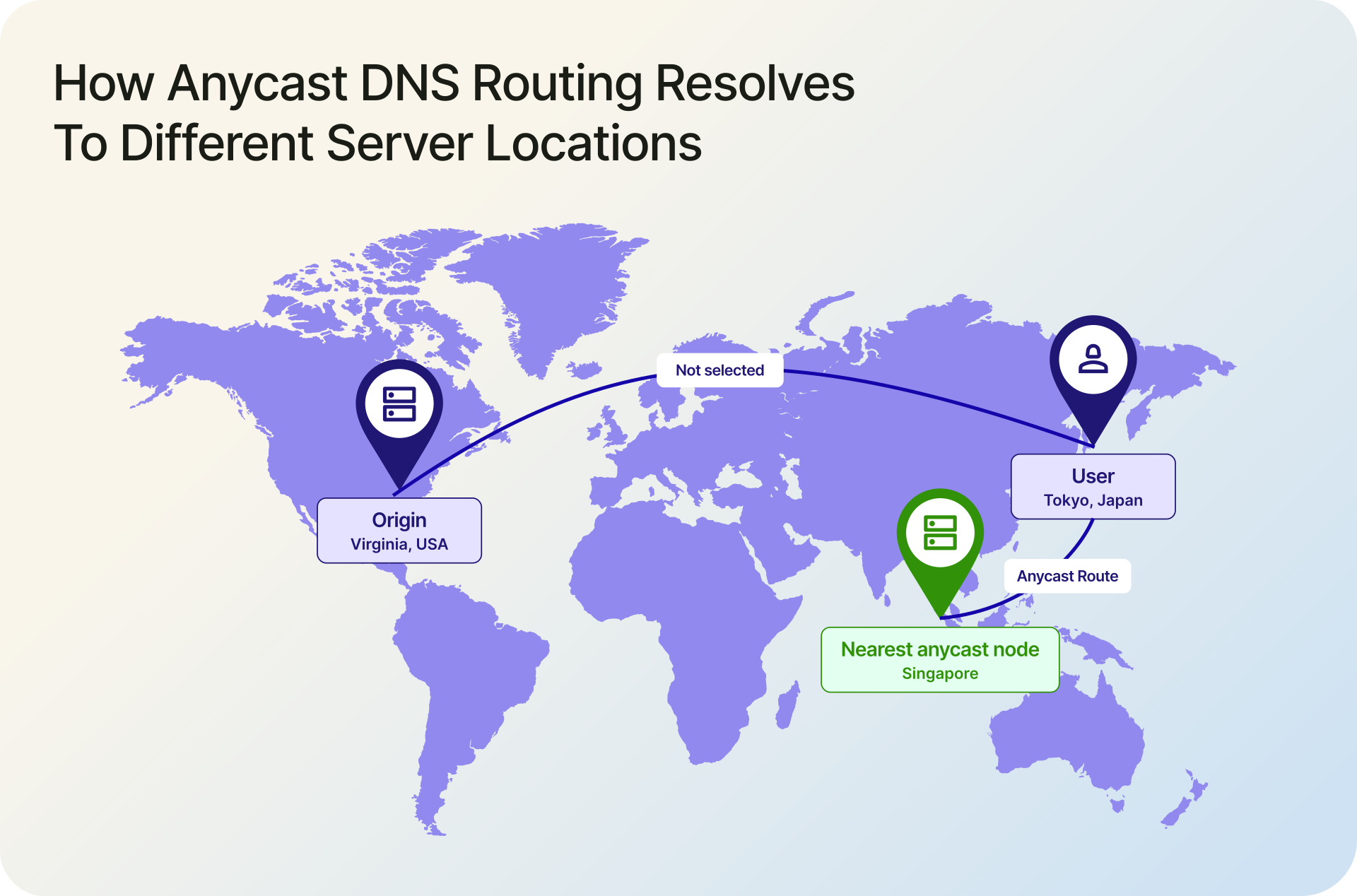
This matters for anyone analyzing network traffic, debugging routing issues, or running compliance checks. If your application geolocates a CDN edge IP or a DNS resolver IP, the result tells you where the infrastructure is, not where the user is. Misinterpreting that data leads to incorrect assumptions about visitor location.
The ipgeolocation.io API addresses this with an is_anycast boolean field in the response. When this field returns true, applications know the queried IP is part of an anycast deployment, meaning the geolocation result reflects a specific node, not a fixed origin. For CDN operators, DNS providers, and security teams, this distinction makes geolocation data significantly more actionable: you can filter anycast IPs from analytics, flag them in compliance checks, or route them through different logic than standard unicast lookups. The API pricing and plans page covers what is included at each tier.
FAQ
Unicast is one-to-one communication where a single sender transmits data to a single, specific receiver identified by a unique IP address. It is the most common network communication model. HTTP web requests, email delivery via SMTP, file transfers over FTP, and SSH sessions all use unicast. TCP and UDP both support unicast, and it works across the entire internet without any special router configuration.
Broadcast sends a single packet to every device on a local network segment. The sender uses a broadcast address (255.255.255.255 in IPv4 or a subnet-specific address like 192.168.1.255), and every device on the subnet must process the packet. ARP and DHCP depend on broadcast for discovery. Broadcast does not cross routers by default and has been completely eliminated in IPv6, replaced by multicast.
Multicast is one-to-many communication where data is sent from one source to a group of receivers that have subscribed using IGMP (IPv4) or MLD (IPv6). Only group members receive the traffic. IPv4 multicast uses the 224.0.0.0 to 239.255.255.255 address range. IPTV, video conferencing, and routing protocols like OSPF are common multicast use cases. It is highly bandwidth-efficient because the network replicates packets only where subscribers exist.
Anycast assigns the same IP address to multiple servers in different geographic locations. When a client sends a packet to an anycast address, BGP routing delivers it to the topologically nearest server. The client does not know other servers exist. Google's 8.8.8.8 and Cloudflare's 1.1.1.1 are well-known anycast deployments. Anycast provides low latency, automatic failover, and DDoS resilience, making it the standard for DNS and CDN infrastructure.
TCP is unicast. It establishes a stateful, one-to-one connection between a client and a server with a three-way handshake. Every TCP session has exactly two endpoints. Multicast applications use UDP instead, because multicast requires connectionless delivery to multiple receivers simultaneously. TCP's reliability guarantees (acknowledgments, retransmission, ordering) are fundamentally tied to its point-to-point design.
Netflix uses unicast. Every subscriber receives an individual HTTPS stream from the nearest CDN edge server. Some ISPs use multicast for IPTV services (traditional cable-style channels), but Netflix's on-demand, personalized streaming model requires separate unicast connections. The tradeoff is higher bandwidth consumption at the CDN edge, which Netflix manages through its Open Connect CDN appliances deployed inside ISP networks.
Yes. Google's public DNS address 8.8.8.8 is served from data centers across dozens of countries using anycast routing. When you send a DNS query to 8.8.8.8, BGP routes it to the nearest Google DNS node. Cloudflare's 1.1.1.1 and the 13 root DNS server authorities operate the same way. Anycast is the standard architecture for public DNS resolvers.
No. IPv6 removed broadcast entirely. RFC 4291, the IPv6 addressing architecture specification, states: "There are no broadcast addresses in IPv6, their function being superseded by multicast addresses." The all-nodes multicast address ff02::1 serves a similar purpose for reaching all devices on a local link, but with the key difference that devices process multicast traffic through group membership rather than being forced to accept every packet.
Anycast is a routing strategy; BGP is the protocol that implements it. Anycast means assigning the same IP address to servers in multiple locations so the network can route each request to the nearest one. BGP is how those servers advertise their shared IP prefix to the internet's routing infrastructure. Without BGP, routers would have no way to know that multiple paths to the same IP exist or to select the shortest one.