



Bogon IP Addresses
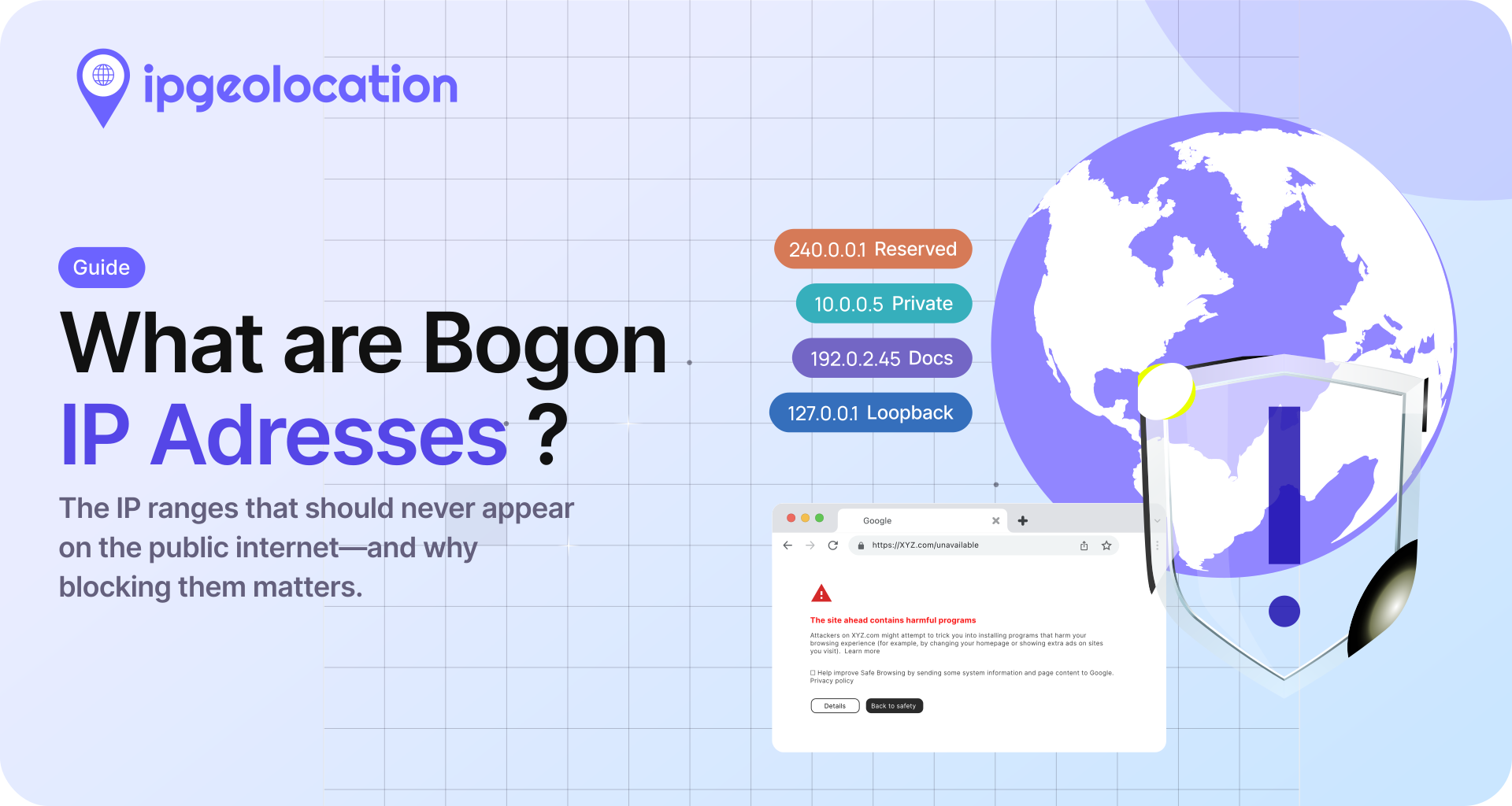
Bogon IP Addresses are the set of IP Addresses not assigned to any entity by Internet Assigned Numbers Authority (IANA) and RIR (Regional Internet Registry). This unallocated address space is called the bogus space. Bogons also include reserved private address and link-local address ranges (Martian Packets). IANA might assign Bogon IP addresses to an entity or RIR with the passage of time.
Here are the bogon IP address ranges:
IPv4 Bogon Ranges
| Netblock | Description |
|---|---|
| 0.0.0.0/8 | "This" network |
| 10.0.0.0/8 | Private-use networks |
| 100.64.0.0/10 | Carrier-grade NAT |
| 127.0.0.0/8 | Loopback |
| 127.0.53.53 | Name collision occurrence |
| 169.254.0.0/16 | Link local |
| 172.16.0.0/12 | Private-use networks |
| 192.0.0.0/24 | IETF protocol assignments; contains more-specific exceptions. Do not block the whole /24 without honoring the IANA registry. |
| 192.0.2.0/24 | TEST-NET-1 |
| 192.168.0.0/16 | Private-use networks |
| 198.18.0.0/15 | Network interconnect device benchmark testing |
| 198.51.100.0/24 | TEST-NET-2 |
| 203.0.113.0/24 | TEST-NET-3 |
| 224.0.0.0/4 | Multicast |
| 240.0.0.0/4 | Reserved for future use |
| 255.255.255.255/32 | Limited broadcast |
IANA marks two addresses inside 192.0.0.0/24 as globally reachable: 192.0.0.9/32 (Port Control Protocol anycast, RFC 7723) and 192.0.0.10/32 (TURN anycast, RFC 8155). Derive operational filters from the current IANA IPv4 Special-Purpose Address Registry, not this simplified table.
IPv6 Bogon Ranges
| Netblock | Description |
|---|---|
| ::/128 | Node-scope unicast unspecified address |
| ::1/128 | Node-scope unicast loopback address |
| ::ffff:0:0/96 | IPv4-mapped addresses |
| ::/96 | IPv4-compatible addresses |
| 100::/64 | Remotely triggered black hole addresses |
| 2001:10::/28 | Overlay routable cryptographic hash identifiers (ORCHID) |
| 2001:db8::/32 | Documentation prefix |
| fc00::/7 | Unique local addresses (ULA) |
| fe80::/10 | Link-local unicast |
| fec0::/10 | Site-local unicast (deprecated) |
| ff00::/8 | Multicast (Note: ff0e::/16 is global scope and may appear on the global internet.) |
IPv6 Additional Bogon Ranges
| Netblock | Description |
|---|---|
| 2002::/24 | 6to4 bogon (0.0.0.0/8) |
| 2002:a00::/24 | 6to4 bogon (10.0.0.0/8) |
| 2002:7f00::/24 | 6to4 bogon (127.0.0.0/8) |
| 2002:a9fe::/32 | 6to4 bogon (169.254.0.0/16) |
| 2002:ac10::/28 | 6to4 bogon (172.16.0.0/12) |
| 2002:c000::/40 | 6to4 bogon (192.0.0.0/24) |
| 2002:c000:200::/40 | 6to4 bogon (192.0.2.0/24) |
| 2002:c0a8::/32 | 6to4 bogon (192.168.0.0/16) |
| 2002:c612::/31 | 6to4 bogon (198.18.0.0/15) |
| 2002:c633:6400::/40 | 6to4 bogon (198.51.100.0/24) |
| 2002:cb00:7100::/40 | 6to4 bogon (203.0.113.0/24) |
| 2002:e000::/20 | 6to4 bogon (224.0.0.0/4) |
| 2002:f000::/20 | 6to4 bogon (240.0.0.0/4) |
| 2002:ffff:ffff::/48 | 6to4 bogon (255.255.255.255/32) |
| 2001::/40 | Teredo bogon (0.0.0.0/8) |
| 2001:0:a00::/40 | Teredo bogon (10.0.0.0/8) |
| 2001:0:7f00::/40 | Teredo bogon (127.0.0.0/8) |
| 2001:0:a9fe::/48 | Teredo bogon (169.254.0.0/16) |
| 2001:0:ac10::/44 | Teredo bogon (172.16.0.0/12) |
| 2001:0:c000::/56 | Teredo bogon (192.0.0.0/24) |
| 2001:0:c000:200::/56 | Teredo bogon (192.0.2.0/24) |
| 2001:0:c0a8::/48 | Teredo bogon (192.168.0.0/16) |
| 2001:0:c612::/47 | Teredo bogon (198.18.0.0/15) |
| 2001:0:c633:6400::/56 | Teredo bogon (198.51.100.0/24) |
| 2001:0:cb00:7100::/56 | Teredo bogon (203.0.113.0/24) |
| 2001:0:e000::/36 | Teredo bogon (224.0.0.0/4) |
| 2001:0:f000::/36 | Teredo bogon (240.0.0.0/4) |
| 2001:0:ffff:ffff::/64 | Teredo bogon (255.255.255.255/32) |
These 6to4 and Teredo rows are derived from the IPv4 table above. The 192.0.0.0/24 rows can stay whole: the block's two globally reachable exceptions, 192.0.0.9 and 192.0.0.10, are PCP and TURN anycast addresses, not 6to4 routers or Teredo servers.