


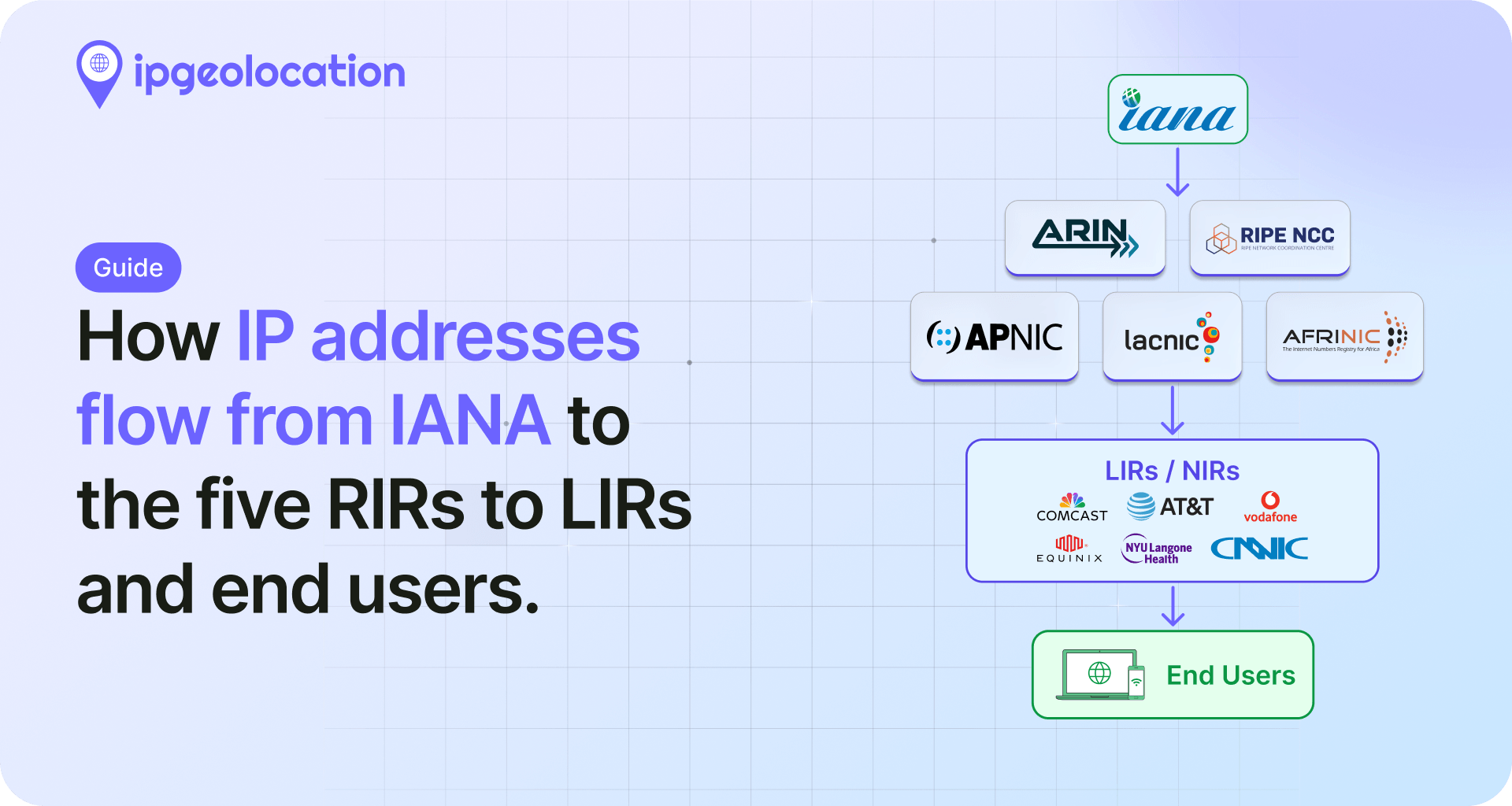
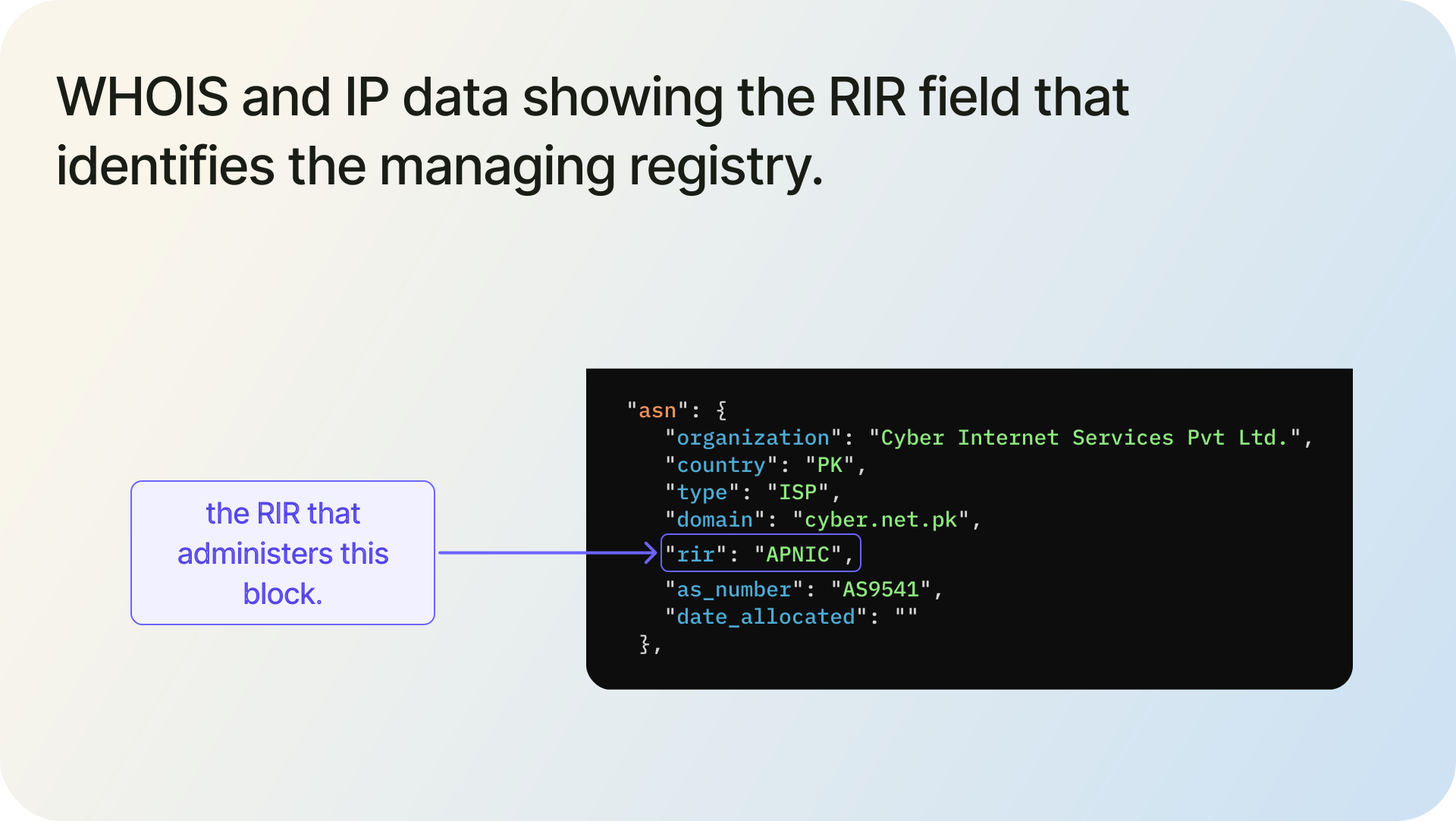
A regional internet registry (RIR) is one of five nonprofit organizations that allocate IP addresses and autonomous system (AS) numbers to networks within a world region. If you have ever run a WHOIS or IP lookup and seen a field like rir: ARIN, that field names the registry that handed out the address block.
RIRs sit one level below IANA in the system that keeps every public IP address and AS number unique. They are easy to overlook until you are tracing who owns an address, reading geolocation data, or trying to register your own IP space. This guide covers what an RIR does, the five that exist, how IANA and local registries fit around them, and why the answer turns up in everyday IP data.
TL;DR
A regional internet registry (RIR) is a nonprofit that manages the allocation and registration of IP addresses and AS numbers for one region of the world. There are five: ARIN, RIPE NCC, APNIC, LACNIC, and AFRINIC. IANA delegates large blocks to each RIR, the RIRs allocate to local internet registries (LIRs, usually ISPs), and LIRs assign to end users.
- The five RIRs are ARIN (North America), RIPE NCC (Europe, Middle East, parts of Central Asia), APNIC (Asia-Pacific), LACNIC (Latin America and the Caribbean), and AFRINIC (Africa).
- They manage IP addresses and AS numbers only, not domain names, which are a separate system.
- The hierarchy runs IANA → RIR → LIR (and, in some regions, NIR) → end user, documented in RFC 7020.
- The five RIRs coordinate through the Number Resource Organization (NRO) and run open, bottom-up policy processes.
- RIR records are the root of WHOIS and RDAP data, which is why the registry shows up in IP intelligence and geolocation results.
What a Regional Internet Registry Does
An RIR does one core job: it manages the allocation and registration of internet number resources, meaning IP addresses (both IPv4 and IPv6) and AS numbers, within its region. "Allocation" is handing a block to an organization. "Registration" is recording who holds it in a public database, so the rest of the internet can see that the block is spoken for and who to contact about it.
That registration role matters more than it sounds. IPv4 has about 4.3 billion addresses in total, and not all of them are usable as public addresses, so the supply is finite: the system only works if each address is assigned to exactly one holder at a time. The RIRs enforce that uniqueness within their regions, and they publish the result through WHOIS and RDAP so anyone can look up the holder of an address.
One point worth being precise about, because plenty of explainers get it wrong: RIRs do not manage domain names. Domain registration runs through a separate chain of registries and registrars under ICANN. An RIR deals in numbers, the addresses and AS numbers that routing depends on, not in example.com.
The Five Regional Internet Registries
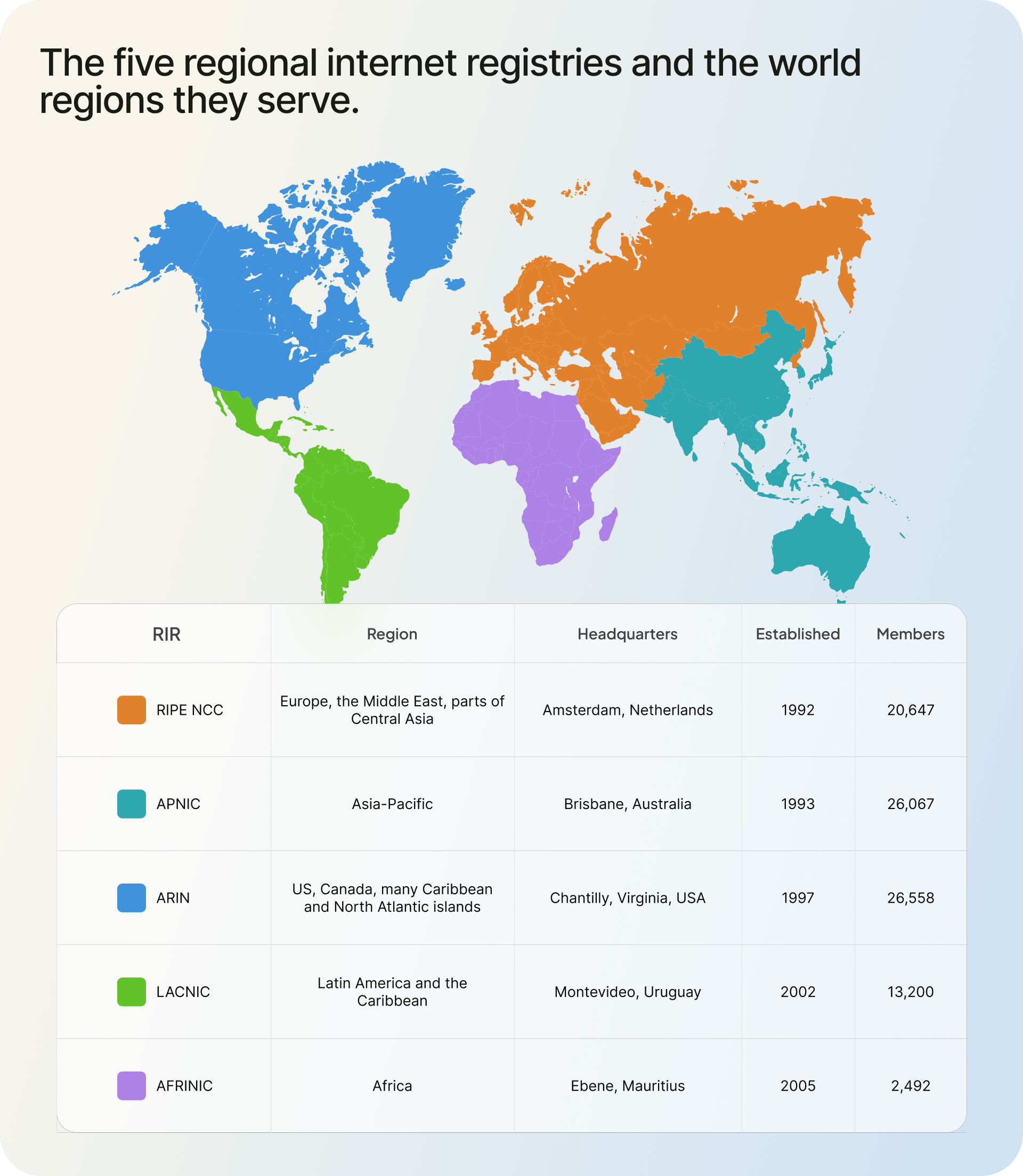
There are five RIRs, each covering a continent-sized region. The table below is drawn from the Number Resource Organization, the body that coordinates all five, with member counts as of December 31, 2025.
| RIR | Region | Headquarters | Established | Members |
|---|---|---|---|---|
| RIPE NCC | Europe, the Middle East, and parts of Central Asia | Amsterdam, Netherlands | 1992 | 20,647 |
| APNIC | Asia-Pacific (East, South, and Southeast Asia, Oceania) | Brisbane, Australia | 1993 | 26,067 |
| ARIN | United States, Canada, and many Caribbean and North Atlantic islands | Chantilly, Virginia, USA | 1997 | 26,558 |
| LACNIC | Latin America and the Caribbean | Montevideo, Uruguay | 2002 | 13,200 |
| AFRINIC | Africa | Ebene, Mauritius | 2005 | 2,492 |
Founding dates follow the NRO. A couple of them depend on which milestone you count: AFRINIC was incorporated earlier but recognized as the fifth RIR in 2005, and LACNIC's own site gives 2002 as its establishment year. The regions are non-overlapping by design, so each allocated public IP block is administered by one RIR.
1. Which RIR Serves the US and Canada (and Every Other Region)
ARIN serves the United States, Canada, and many Caribbean and North Atlantic islands. The other four split the rest of the world: RIPE NCC covers Europe, the Middle East, and parts of Central Asia; APNIC covers the Asia-Pacific; LACNIC covers Latin America and the Caribbean; and AFRINIC covers Africa. To find the RIR for a specific address, look up the rir field in its WHOIS record rather than guessing from the country, since leased and transferred blocks do not always match the geography.
How the System Fits Together: IANA, RIRs, LIRs, and NIRs
RIRs are the middle layer of the internet number registry system, which RFC 7020 documents. At the top is IANA, the Internet Assigned Numbers Authority. IANA is a coordination function rather than a company; today the IANA functions are operated by Public Technical Identifiers (PTI), an affiliate of ICANN. It manages the global pools of IP addresses and AS numbers, delegating large blocks down to the five RIRs.
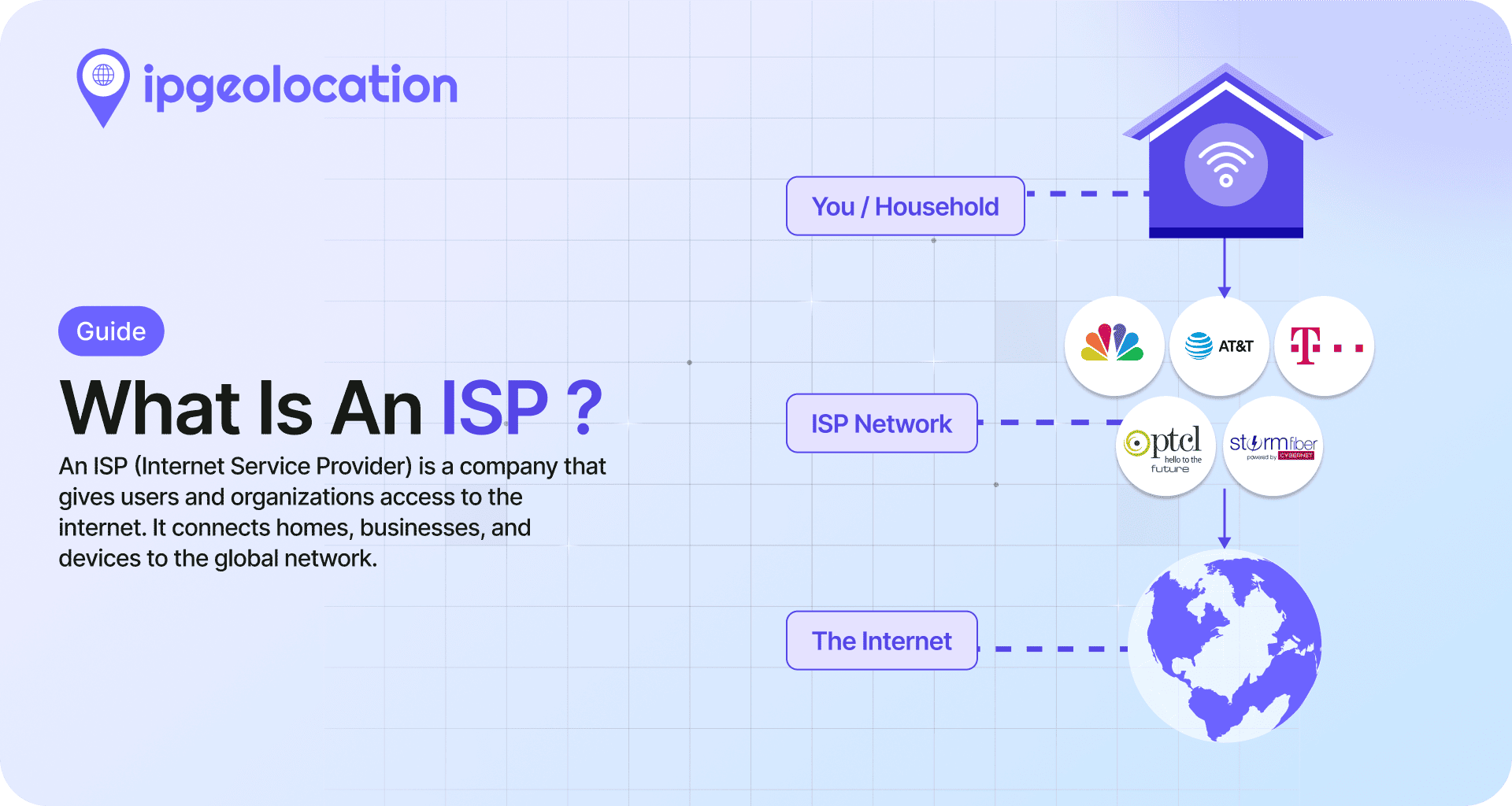
Below the RIRs are local internet registries (LIRs). An LIR is an organization, usually an ISP, that receives a block from its RIR and assigns parts of it to its own customers. Some regions add a national internet registry (NIR) layer between the RIR and LIRs to manage allocations at the country level. NIRs are concentrated in the Asia-Pacific, where APNIC works through several national registries such as JPNIC in Japan and CNNIC in China, with two more in the LACNIC region (NIC.br in Brazil and NIC Mexico). They let large national communities manage allocation and registration in-country; ARIN and RIPE NCC use no national tier, so organizations there deal with the RIR or an LIR directly. End users sit at the bottom: most people and companies get their addresses from an ISP, not directly from an RIR.
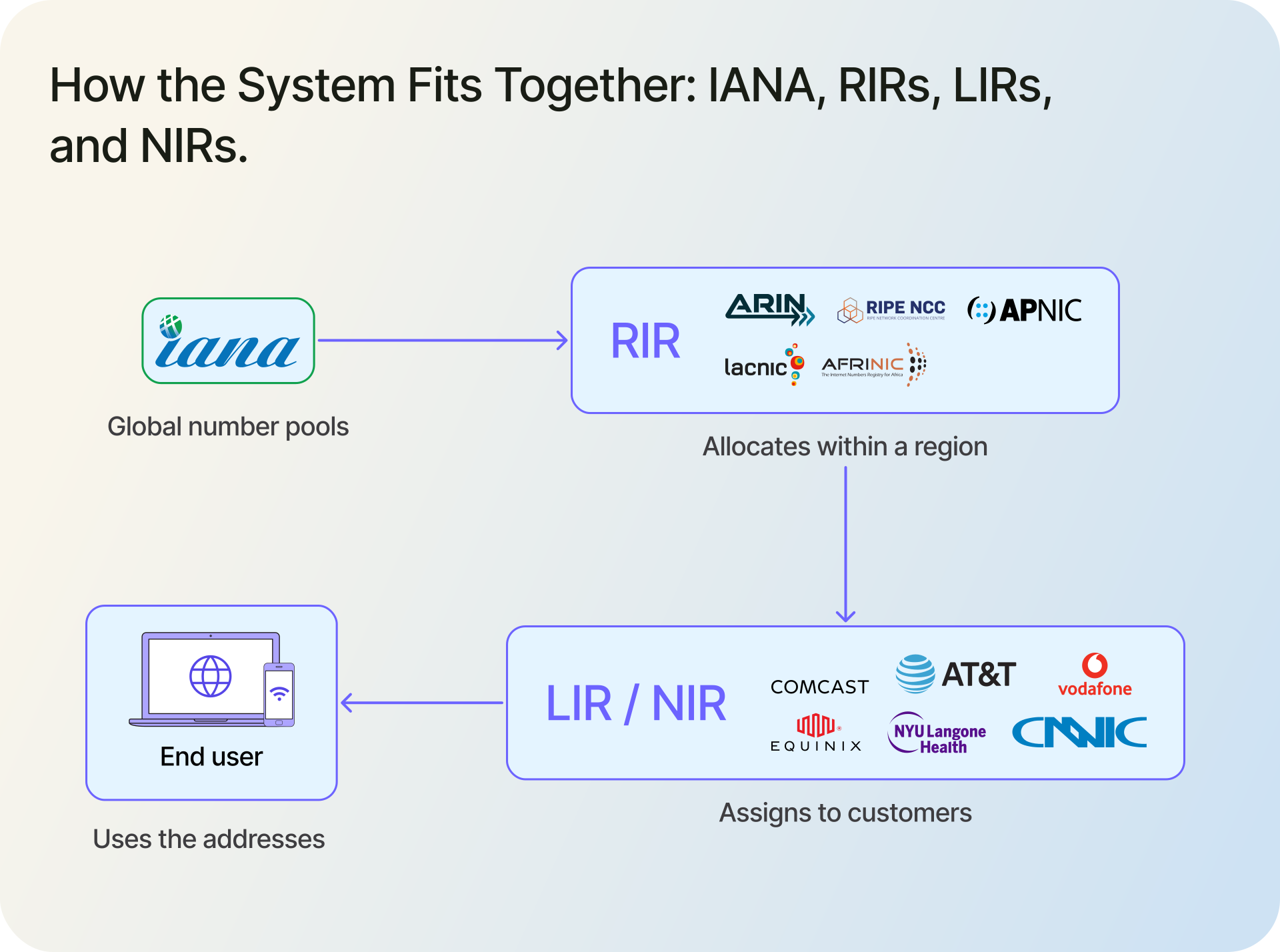
So the chain reads IANA → RIR → LIR (or NIR → LIR) → end user. That structure is why a single IP address can always be traced back to a specific network and registry, and it is the backbone of the autonomous system numbers and ISP relationships you see in IP data.
RIRs, WHOIS, and IP Geolocation
For most people working with IP data, the RIR is not an abstract governance body, it is a field in a lookup. When you query an address, the rir value tells you which registry administers it, and the underlying WHOIS or RDAP record, published by that RIR, carries the registrant, the allocation date, and the abuse contact. Our IP WHOIS data exposes that rir field directly.
This is also where RIRs touch geolocation. Registry allocation is the base layer that says which organization and country a block belongs to, before any finer location work happens. It is a starting point, not the final answer, which is exactly why a good provider verifies it rather than trusting it blindly. Addresses that no RIR has allocated yet are a related edge case, covered in our guide to bogon IP addresses.
1. How to Find the RIR for an IP Address
Run an IP WHOIS or RDAP lookup on the address and read the registry field (often labeled rir or source, or shown as the registration authority). That tells you which of the five registries administers the block. Treat the country in geolocation data as a separate signal: blocks get transferred between regions, leased, or used outside their home region, so the RIR and the physical location do not always line up.
Who Runs and Funds the RIRs
Each RIR is an independent, not-for-profit, member-funded association governed by a board its members elect. Members pay fees based on the resources and services they use, and that funding is what keeps the registries running. Membership is broad: ISPs, hosting providers, governments, universities, and enterprises of every size.
The five RIRs coordinate through the Number Resource Organization (NRO), formed in 2003 to act on matters that affect all of them and to run joint technical and policy work. The NRO also serves as the Address Supporting Organization (ASO) within ICANN, which is how RIR-level policy connects to global internet governance. Crucially, the NRO does not allocate addresses itself; the RIRs do that within their regions.
Policy at each RIR is set bottom-up. Anyone can propose a change, discussion happens on open mailing lists and at public meetings, and proposals are adopted by community consensus rather than by a central authority. If you only remember one thing about RIRs, make it this: they hand out the addresses and keep the registry honest, but they do not decide what you do with the space once it is yours.
A Short History of the RIR System
The RIR model was not the original plan. In the early internet, number assignment was handled centrally, but as the network grew that did not scale. The IETF proposed delegating the work to regional bodies in RFC 1366 (1992), a concept later refined through RFC 1466 and RFC 2050 and documented as it works today in RFC 7020.
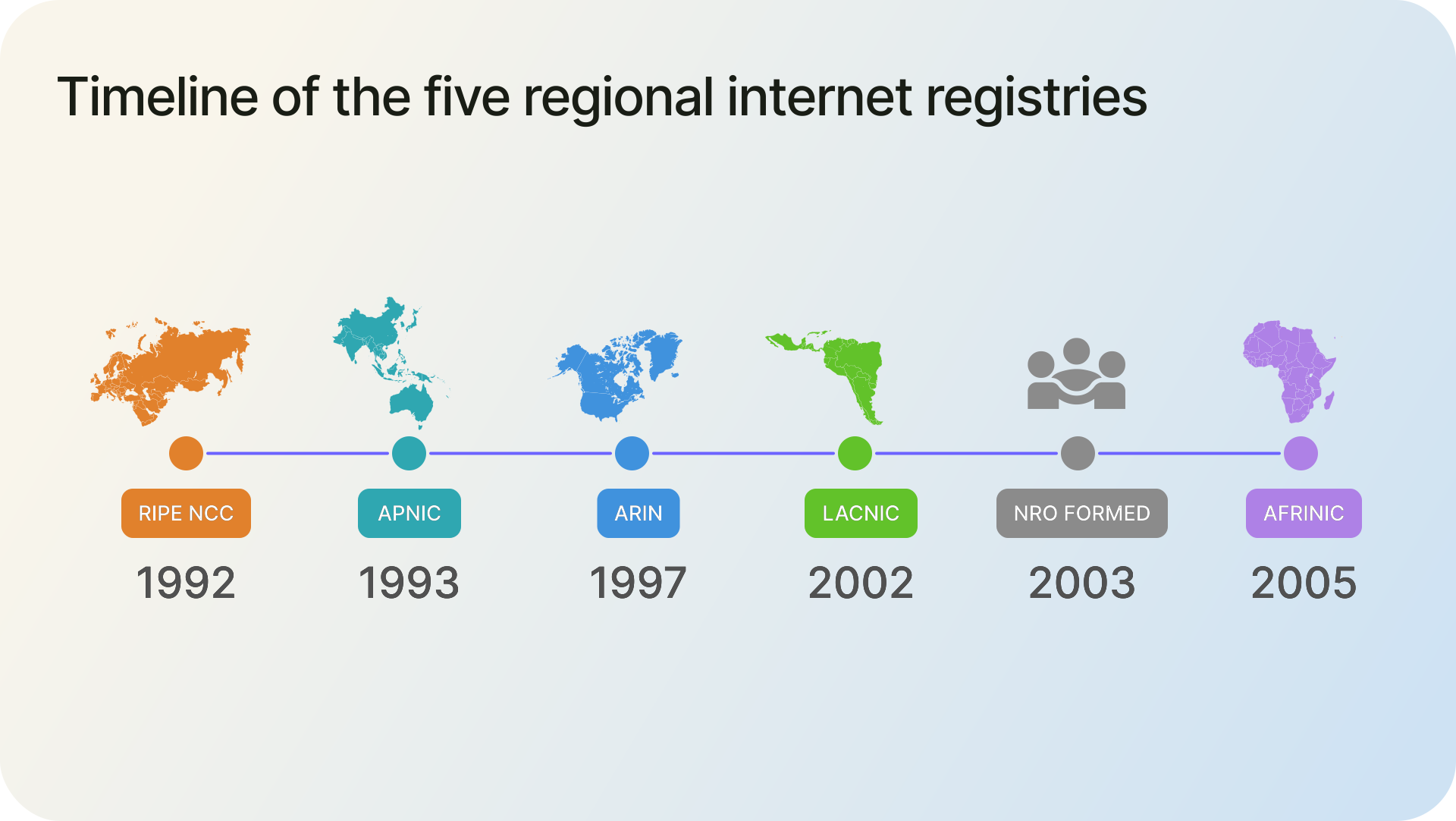
RIPE NCC came first in 1992, serving Europe, followed by APNIC in 1993 for the Asia-Pacific and ARIN in 1997 for North America. LACNIC was established in Uruguay in 2002, and AFRINIC completed the map in 2005 as the registry for Africa. The NRO was formed in 2003 to coordinate the group, with AFRINIC joining once it was recognized. The five-RIR framework has stayed in place since, even through IPv4 exhaustion, because that role only grows more important as free addresses run out.
Frequently Asked Questions
The five RIRs are ARIN (United States, Canada, and parts of the Caribbean), RIPE NCC (Europe, the Middle East, and parts of Central Asia), APNIC (Asia-Pacific), LACNIC (Latin America and the Caribbean), and AFRINIC (Africa). Each one allocates and registers IP addresses and AS numbers within its region.
No one manages the RIRs from above in an operational sense. Each is an independent, member-governed nonprofit. IANA delegates number blocks to them, and the five coordinate voluntarily through the Number Resource Organization (NRO), which also acts as ICANN's Address Supporting Organization for global policy.
ARIN, the American Registry for Internet Numbers, serves the United States and Canada, along with many Caribbean and North Atlantic islands. It was established in 1997 and is headquartered in Chantilly, Virginia. To confirm the registry for a specific address, check the rir field in its WHOIS record.
An RIR is a regional registry that receives large blocks from IANA and allocates them across a multi-country region. A local internet registry (LIR), usually an ISP, receives a block from its RIR and assigns smaller pieces to its own customers. In short, RIRs serve LIRs, and LIRs serve end users.
IANA sits at the top of the hierarchy and manages the global pools of IP addresses and AS numbers, delegating large blocks to the five RIRs. An RIR operates one level down, distributing and registering those resources within a single region. IANA is global and wholesale; an RIR is regional and closer to the operators.
Yes, if you become a member and meet your RIR's policy requirements, though most organizations get space from their ISP instead. IPv6 addresses and AS numbers are generally available to request. IPv4 is harder: free pools are depleted in most regions, so new IPv4 comes mainly through waiting lists or transfers.
What to Do Next
Look up an address you care about and read its rir field to see the registry behind it. If you work with IP data at scale, that registry information, along with the network and organization, comes through the IP Geolocation API and ships in our downloadable IP WHOIS database. For the layers just below the registry, the ASN guide explains how an AS number identifies a network, and how an ISP differs from an ASN covers why IP data keeps the ASN's organization (the network operator) separate from the company behind an IP.