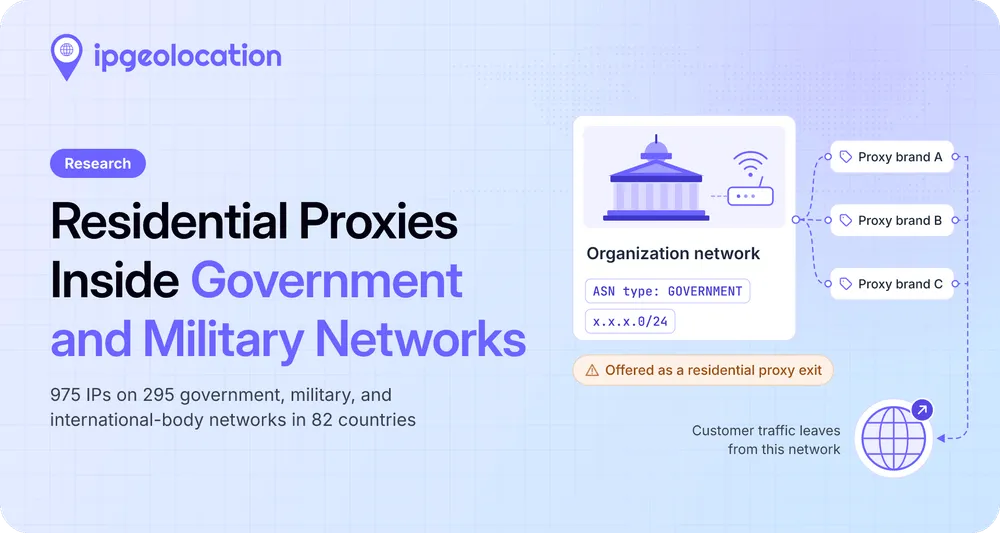

Data: September 11 to November 11, 2026, residential and mobile proxy exits from 57 providers. IP ownership and network type as of November 5 to 12, 2026.
Are residential proxies really residential? Mostly, yes. Of 45.3 million residential and mobile proxy IPv4 exits IPGeolocation.io saw between September 11 and November 11, 2026, 0.85%, or 1 in 118, sat on datacenter networks, and 99.15% sat on ISP and mobile networks. An exit is the address a proxy customer's traffic leaves from, so it's the address a website sees.
59.0% of those datacenter exits sat on VPN networks: VPN servers and datacenter ranges flagged as VPN infrastructure. The likeliest explanation is a real phone or laptop running a proxy app while it's connected to a VPN. The big clouds barely appear: the ten best-known clouds and VPS hosts held 0.03% of all exits.
The share depends on the country. Among exits geolocated in the US, 1 in 24 was a datacenter IP; in India and Egypt it was under 0.1%.
TL;DR
Residential proxies are really residential in the sense that matters to a website: 99.15% of the 45.3 million exits IPGeolocation.io measured across 57 providers between September 11 and November 11, 2026, sat on ISP and mobile networks, and 0.85%, or 1 in 118, on datacenter networks. 59.0% of those datacenter exits sat on VPN networks.
- 37,624 exits were VPN servers our monitoring had connected to: 35.5% were addresses our monitoring had observed as NordVPN servers and 22.4% as Proton VPN servers.
- 28 consecutive addresses our monitoring had seen as Proton VPN servers were each offered as residential exits on 56 to 62 of the 62 days, by 21 to 27 providers.
- 1,200 exits were corporate security gateways, 80.2% of them Zscaler's.
- A datacenter check catches only the 1 in 118 residential proxy exits that sit on datacenter networks, and a datacenter IP isn't automatically a bot: read the VPN and gateway flags before you block.
How we decided what counts as a datacenter IP
We counted an exit as a datacenter IP when it sat on a network that rents out servers, such as a cloud, hosting, or VPS company. A residential IP is one an internet provider or mobile carrier assigns to a subscriber's home connection or phone, which is what a residential proxy is sold as.
Each IPv4 address that providers sold under residential or mobile labels counts once. We count an address as seen on a day if any proxy provider offered it as an exit that day (UTC), the same rule as in our research on how long residential proxy IPs last. Each exit went through two checks:
- Server evidence at the address. We matched every exit against the VPN servers our monitoring had connected to, server-based VPNs only (how VPN detection works), and against the egress ranges of corporate security gateways from Zscaler, Netskope, Cisco Umbrella, Fortinet, Broadcom, and Skyhigh, whose addresses also turn up in residential proxy pools.
- The network. We checked who operates the network and how its addresses behave, drawing on our own IP data: the ASN that announces the block and what kind of network it is (access ISP, mobile carrier, transit network, or hosting company), the connection type (DSL, fiber, mobile), our verified list of hosting networks, and on how many days and by how many providers each address was offered.
Every exit landed in one of these classes:
| Class | IPv4 Exits | Share Of All Exits |
|---|---|---|
| ISP or mobile network | 44,883,139 | 99.15% |
| VPN server we connected to | 37,624 | 0.083% |
| Corporate security gateway | 1,200 | 0.003% |
| Hosting range flagged as VPN | 189,525 | 0.419% |
| Other hosting network | 156,491 | 0.346% |
| Total | 45,267,979 | 100% |
The last four rows are the datacenter exits: 384,840, or 0.85% of the total. However the borderline cases are counted, the share stays between 0.83% and 1.01%, or 1 in 120 to 1 in 99.

What the datacenter exits are
The 384,840 datacenter exits fall into three groups: 59.0% sat on VPN networks (9.8% on VPN servers we matched directly and 49.2% in datacenter ranges flagged as VPN infrastructure), 40.7% on other servers and hosting, and 0.3% on corporate security gateways.
1. VPN servers and VPN networks sold as residential exits
Two kinds of VPN address were sold as residential exits:
- VPN servers we connected to: 37,624 exits, 9.8% of the datacenter exits.
- Datacenter ranges flagged as VPN infrastructure: 189,525 exits, 49.2%. Our VPN detection flags these ranges as VPN infrastructure from what it finds in the range itself, not from the name of the company that hosts it, and most of these flags don't name a VPN brand.
The matched VPN servers were addresses our monitoring had observed as:
- NordVPN servers: 35.5%
- Proton VPN servers: 22.4%
- Private Internet Access servers: 11.9%
- Surfshark servers: 10.2%
- Windscribe servers: 7.8%
- Others: TunnelBear 2.3%, FastVPN 1.9%, ExpressVPN 1.3%, VyprVPN 1.3%, PureVPN 1.0%, and other brands 7.6%
Some addresses matched two brands, so the shares add up to 103.2%. A brand's share says where the proxy traffic left, and nothing in the data says a VPN company is involved.

The likeliest path from a VPN server to a residential pool:
- Someone installs an app that carries a proxy SDK, or a bandwidth-sharing app that pays for their spare connection, on a phone or laptop that also runs a consumer VPN.
- A proxy provider sends a customer's request to that device.
- The device sends it on through its VPN tunnel, so the website sees the VPN server's datacenter IP, sold as residential.

Many people share one VPN server address, so VPN exits stay on offer far longer than home connections. Compared with exits on ISP and mobile networks, the VPN servers we matched were:
- Seen on more days: 8.85 of the 62 days on average, against 4.87.
- Rarely one-day exits: 23.7% were seen on a single day, against 43.3%.
- Often long-lived: 32.8% were seen on 8 or more days, against 16.8%.
- Widely resold: 34.8% were offered by 5 or more providers, against 23.6%.
All datacenter exits sat in between (31.0% seen on one day, 25.8% on 8 or more), and exits sold only as datacenter proxies stayed longest, at 24.2% and 49.5%.

Some VPN addresses are on offer almost every day. 28 consecutive addresses in 205.147.22.x, on Proton AG's network (AS208172), which our monitoring had seen as Proton VPN servers, were each offered as residential exits on 56 to 62 of the 62 days, by 21 to 27 different proxy providers.
A VPN address sold as a residential exit carries two risks at once: the anonymity of a VPN and the strangers renting it as a proxy exit. Our known-attacker flag, which draws on our honeypots and threat feeds, was on 58.7% of exits in VPN-flagged ranges and 21.2% of the VPN servers we matched.
Each flag is a risk signal with its own evidence (how to read IP risk signals). The residential proxy example on our IP Security API page shows both risks on one address. A lookup on 145.223.7.7 returns (trimmed):
{
  "ip": "145.223.7.7",
  "security": {
    "threat_score": 90,
    "is_residential_proxy": true,
    "proxy_provider_count_30d": 9,
    "is_vpn": true,
    "vpn_provider_names": ["SurfShark VPN"],
    "is_known_attacker": true,
    "is_cloud_provider": true,
    "cloud_provider_name": "Brander Group Inc."
  }
}
It's a Surfshark VPN server on a hosting network, with a known-attacker flag, and 9 proxy providers offered it as a residential exit in the last 30 days. The lookup page for 145.223.7.7 shows the same flags.
2. Corporate security gateways
1,200 exits were the egress addresses of corporate security gateways, the cloud services companies route employees' web traffic through: Zscaler 962 (80.2%), Cisco Umbrella 116, Netskope 92, Fortinet 18, Skyhigh 10, and Broadcom 2. A work laptop or phone runs an app with a proxy SDK, the company sends its web traffic through the gateway, and the proxy customer's request leaves from the gateway's address. 62.8% of these exits were seen on one day only, and 67.4% were offered by a single provider, which points to individual work devices rather than the gateways themselves. In our published data, all 1,200 carry the corporate gateway flag.
Gateway addresses usually sit on the vendor's own cloud address space, which is why they count among the datacenter exits here. Our data flags them as corporate gateways, though, and keeps their anonymity and abuse flags clear, so a rule can treat them as a company's traffic rather than as datacenter or VPN traffic. Blocking one would block a whole company's staff (how VPN and proxy flags turn into false positives). Our research on residential proxy exits on government and military networks looks at the same problem from the network owner's side.
3. Servers and cloud platforms
The other 156,491 datacenter exits sat on servers with no VPN evidence, and the big clouds barely appear among them. The ten best-known clouds and VPS hosts held 12,889 exits, 0.03% of all exits:
| Cloud Or Host | Exits |
|---|---|
| OVHcloud | 3,854 |
| AWS | 2,759 |
| Hetzner | 1,946 |
| DigitalOcean | 1,268 |
| Akamai/Linode | 946 |
| Vultr | 697 |
| Microsoft Azure | 507 |
| Oracle Cloud | 419 |
| Alibaba Cloud | 269 |
| Google Cloud | 224 |
| Total | 12,889 |
Most of this group sat on hosting and VPS companies outside the big clouds, such as Aire Networks, GSL Networks, F.N.S. Holdings, Latitude.sh, Leaseweb, HOSTKEY, and Timeweb. On the cloud platform Railway (AS400940), 2,007 exits were on offer, 60.7% of them on 8 or more days, and one address in 152.55.178.x was offered by 10 providers on 20 days, which fits bandwidth-sharing apps running in containers on the platform.
Servers can also join a pool without their owner's consent. Sysdig's threat research team documented proxyjacking on compromised servers: an attacker who broke into a server through the Log4j vulnerability installed a proxyware client to sell its bandwidth.
ISP proxies in rotating residential pools
An ISP proxy is a server in a datacenter that uses addresses registered to a consumer or business internet provider, often sold as a "static residential" proxy. In a rotating residential pool, one provider's ISP-proxy block would show up as a run of addresses on offer almost every day from that provider alone, and that pattern didn't show up. Outside hosting ranges, 1,708 /24 blocks held 210,566 addresses seen on 30 or more of the 62 days, and only 4 of those addresses were offered by a single provider. Almost all belonged to mobile carriers and other carriers that share one public address among many subscribers (carrier-grade NAT, or CGNAT), resold by many providers.
Where datacenter exits concentrate
Datacenter exits cluster where VPN servers and hosting companies are, so the share depends on the country an exit is geolocated to. 1 in 24 residential proxy exits geolocated in the US (4.16%) was a datacenter IP, and in the Netherlands 17.58%, about 1 in 6; in India it was 0.07%, and in Egypt, Morocco, and Algeria 0.01% each.
| Country | Exits | Datacenter | On VPN Networks |
|---|---|---|---|
| Netherlands | 178,685 | 17.58% | 8.49% |
| Finland | 57,020 | 17.24% | 6.08% |
| Sweden | 82,922 | 8.95% | 4.96% |
| Hong Kong | 68,785 | 6.58% | 2.38% |
| Germany | 831,001 | 4.18% | 2.12% |
| United States | 2,894,092 | 4.16% | 2.95% |
| Canada | 431,114 | 2.56% | 2.12% |
| United Kingdom | 1,040,931 | 2.23% | 1.54% |
| France | 471,241 | 1.91% | 1.30% |
| Japan | 433,831 | 1.12% | 0.55% |
| Russia | 2,925,273 | 0.32% | 0.08% |
| Brazil | 3,959,789 | 0.20% | 0.06% |
| China | 1,059,298 | 0.11% | 0.01% |
| India | 2,786,966 | 0.07% | 0.02% |
| Egypt | 2,025,393 | 0.01% | 0.00% |
For a fraud team watching US or Western European traffic, the global 1 in 118 understates what you'll see: 4.16% (1 in 24) of US-geolocated exits and 4.18% of German ones were datacenter IPs.

The share also varies by provider: across the 56 providers with at least 50,000 exits, it ran from 0.11% to 5.05%, with a median of 0.58%. The highest was a peer-to-peer bandwidth-sharing marketplace open to anyone who installs its app, and 3.41 points of its 5.05% sat in VPN-flagged datacenter ranges.
Day by day, mobile proxies, and IPv6
The datacenter share stays small however the exits are cut: by day, by product label, or by IP version.
1. Day by day
On any single day, datacenter networks held 1.00% (October 30) to 1.43% (November 7) of the exits on offer, and 1.20% on average. That's above the 0.85% for the whole window because datacenter exits stay in pools longer than home addresses.

2. Mobile proxies
Exits sold only under mobile proxy labels, 690,225 of them, were the least likely to be datacenter IPs, at 0.34%. Exits sold only under residential labels came in at 0.87%, and exits sold under both at 0.52%.
3. IPv6
Of 16.33 million IPv6 exits, 12,036 (0.07%) sat on datacenter networks, far below the 0.85% for IPv4.
How to check whether a residential proxy IP is really a datacenter IP
To check whether an IP is residential or datacenter, look at the network, then at how the address behaves, then at the VPN and gateway evidence.
- The network and its type. Find the autonomous system number (ASN) that announces the address and what kind of network it is: an access ISP or mobile carrier, a transit network, or a hosting company.
- The registered organization. Check who the block is registered to at the regional internet registries; it can differ from the network that routes the address, which how to read IP ownership records explains.
- The connection type. A connection type such as DSL, fiber, cable, or mobile marks a subscriber line rather than a server.
- How the address behaves over days. An address on offer most days from many providers is a shared exit, such as a VPN server, a gateway, or a carrier's CGNAT address. In our data, VPN servers were seen on 8 or more days about twice as often as home and mobile exits (32.8% against 16.8%).
- VPN and gateway evidence. A datacenter address can be a VPN server or a company's security gateway, and each calls for a different decision.
One IP Security API lookup returns the hosting, VPN, gateway, and residential proxy evidence together: is_cloud_provider with the provider's name, is_vpn with vpn_provider_names, is_corporate_gateway with the gateway type and vendor, and is_residential_proxy with proxy_provider_count_30d (the IP Security API field reference lists them all). For detection methods beyond the network, see how residential proxy detection works.
What this means for fraud and security teams
- A hosting check isn't a residential proxy check. 99.15% of residential proxy exits sat on ISP and mobile networks, so a hosting or datacenter flag catches only the 1 in 118 on datacenter networks. Residential proxies need a flag of their own, one that marks the address as a proxy exit whatever network holds it.
- A datacenter IP isn't automatically a bot or a server. Real people sit behind VPN servers and corporate gateways, and 59.0% of the datacenter exits in residential pools were on VPN networks. Read the VPN and gateway flags before you block.
- Expect more datacenter exits in US and Western European traffic. 4.16% of US-geolocated exits and 4.18% of German ones were datacenter IPs, nearly five times the 0.85% across all countries.
- Treat a VPN address sold as a residential exit as two risks. It hides its user like any VPN and is rented to strangers like any proxy exit. 58.7% of exits in VPN-flagged ranges and 21.2% of the VPN servers we matched carried a known-attacker flag.
- Test the connection when the address has no history. Real-Time Proxy & VPN Detection runs live network tests on the visitor's connection from the browser and reaches its verdict without consulting an IP database, so it can flag an exit no list has seen yet.
Method
The data covers exits sold under each provider's residential, mobile, and datacenter product labels from September 11 to November 11, 2026, across 57 residential and mobile proxy providers, with sightings deduplicated by address, provider, label, and day. That came to 377 million sightings in all, covering 45.3 million IPv4 and 16.33 million IPv6 residential and mobile exits, plus about 763,000 exits sold under datacenter labels. Every figure counts addresses in rotating residential and mobile products, each address once.
VPN server evidence comes from servers our monitoring connected to between February and November 2026, hosting ranges from our November 11, 2026 build, IP-to-network, country, and connection type from our November 5, 2026 export, and known-attacker flags from our November 11, 2026 security build.
How IPGeolocation.io flags residential proxies, VPNs, and gateways
IPGeolocation.io sells IP data, and the security data used in this research is part of it. Our APIs and databases cover geolocation, security (VPN, proxy, residential proxy, and Tor detection with a threat score), ASN, company, abuse contact, time zone, and user agent data.
An address that is a residential proxy exit and a VPN server at once needs both facts reported, and our flags do that. The Proxy & VPN Detection API returns the residential proxy, VPN, gateway, and hosting flags from the how-to section with their provider names and last-seen dates, for one address or up to 50,000 in a bulk request. In our November 11, 2026 security build, 98.7% of the 384,840 datacenter exits in this research carry is_residential_proxy, and 98.7% carry it alongside is_vpn or is_cloud_provider, so a rule can tell them apart from home exits; 58.6% carry is_vpn.
The IP Security Database carries the same flags for local lookups and is updated daily, and the Residential Proxy Database lists residential proxy ranges with the proxy provider and the last-seen date. For exits no list has recorded yet, Real-Time Proxy & VPN Detection tests the session itself. Compare API plans and pricing to see which plan includes security data.
Frequently asked questions
Mostly, yes. Of 45.3 million residential and mobile proxy IPv4 exits IPGeolocation.io saw between September 11 and November 11, 2026, 99.15% sat on ISP and mobile networks and 0.85%, or 1 in 118, on datacenter networks. 59.0% of those datacenter exits were on VPN networks.
Rarely. 0.85% of the residential proxy exits IPGeolocation.io measured were datacenter IPs, and 59.0% of those sat on VPN networks: VPN servers and datacenter ranges flagged as VPN infrastructure. The ten best-known clouds and VPS hosts held only 0.03% of all exits.
A datacenter IP is an address on a network that rents out servers, such as a cloud, hosting, or VPS company. A residential IP is one an internet provider or mobile carrier assigns to a subscriber's home connection or phone. The label describes the network, not the person: a residential IP can carry proxy traffic, and a datacenter IP can carry a real person through a VPN or a corporate gateway.
Not quite. An ISP proxy is a server in a datacenter that uses addresses registered to an internet provider, often sold as "static residential", while a rotating residential proxy routes traffic through subscribers' own devices. Both look residential in registration data. In rotating residential pools, IPGeolocation.io found only 4 of 210,566 persistent addresses offered by a single provider, so the single-provider block pattern of ISP proxies didn't show up there.
A commercial VPN server's IP is usually a datacenter IP; peer-to-peer and volunteer VPNs are the exception, since their exits are people's home connections. VPN servers also turn up in residential proxy pools: 37,624 of the residential proxy exits IPGeolocation.io measured were addresses its monitoring had connected to as VPN servers.
Not on its own. In IPGeolocation.io's data, 99.15% of residential proxy exits sat on ISP and mobile networks, so a hosting check catches only the 1 in 118 that sit on datacenter networks. Catching the rest takes a residential proxy flag, which marks the address as a proxy exit whatever network holds it.
Updates
- First published with data from September 11 to November 11, 2026.