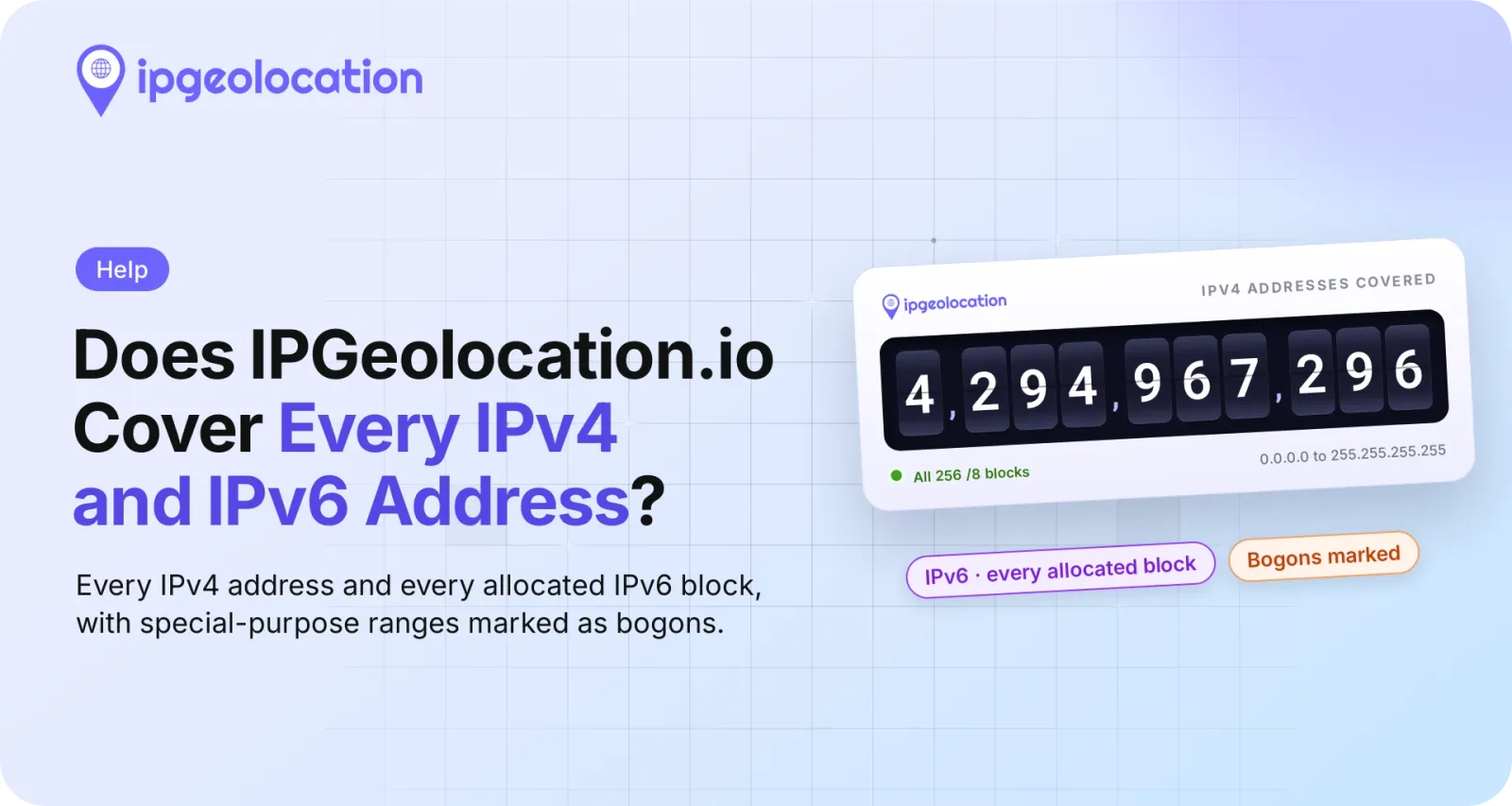
IPGeolocation.io covers every IPv4 address, all 4,294,967,296 of them, and every IPv6 address in the blocks IANA has allocated to the five regional internet registries, whether or not a network uses it on the internet yet. Covered doesn't always mean located: the special-purpose ranges, such as private and documentation addresses, are bogons, so the API answers them with HTTP 423 and the database files mark them with the country code ZZ.
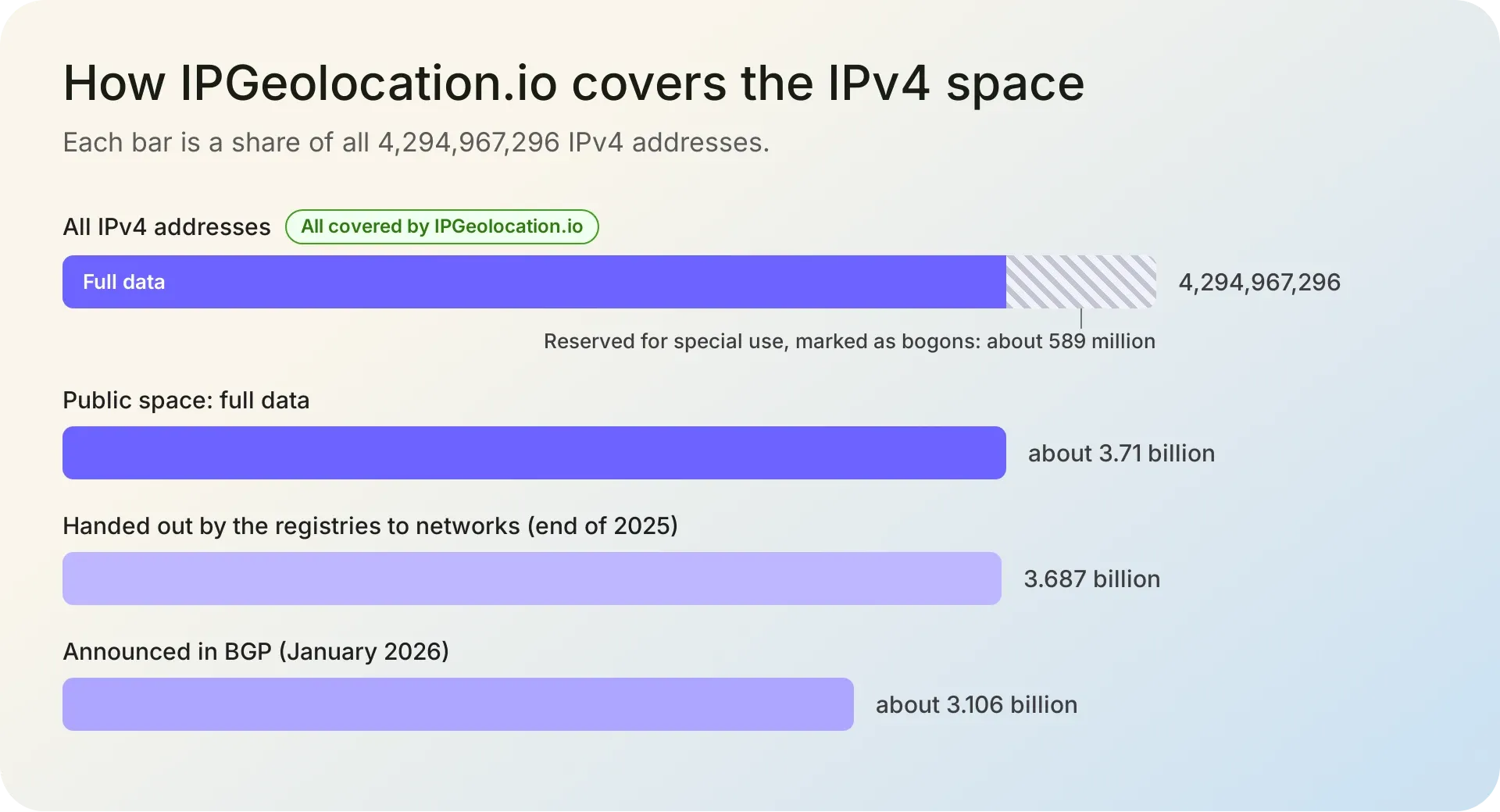
In IPv4, the addresses that get full data are all 256 /8 blocks, the older legacy blocks included, apart from the special-purpose ranges: about 3.71 billion addresses. That is more than the roughly 3.1 billion addresses networks announced in January 2026, because our data also covers space that is allocated but idle.
What counts as the IP address space
The part of the address space that matters for location data is the part that can appear on the internet, and in IPv4 that leaves out about 589 million addresses reserved for special purposes. When you compare coverage claims, ours included, ask how much of that public space returns data, not whether a provider has a row for every 32-bit value. From the whole range down to what networks announce:
| Part Of The IPv4 Space | Addresses |
|---|---|
| All IPv4 addresses, all covered by IPGeolocation.io | 4,294,967,296 |
| Reserved for special purposes (multicast, future use, private networks, loopback, and smaller blocks): marked as bogons | about 589 million (35.078 /8 blocks) |
| Public space, everything else: full data | about 3.71 billion (220.922 /8 blocks) |
| Handed out by the registries to networks (end of 2025) | 3.687 billion |
| Announced in BGP (January 2026) | about 3.106 billion |
The reserved and public figures come from the IPv4 Address Report on potaroo.net, and the handed-out and announced figures from Geoff Huston's IP addresses through 2025 on the APNIC Blog. Full data reaches the whole public space, so it also takes in addresses the registries haven't handed out yet.
"Announced in BGP" means a network is telling the rest of the internet, through its routing system, that it carries those addresses. Roughly half a billion handed-out addresses aren't announced. We still return a record for them, so a block that comes online already has data. When a block moves to a new holder or a network announces it for the first time, our data usually shows the change within 24 hours; the update frequency article covers how quickly each kind of change reaches our data.
IPv6 is a different scale. IANA assigns unicast space only from 2000::/3, and about 85% of the whole IPv6 space is reserved for future use, according to IANA's IPv6 Address Space registry. Inside 2000::/3, IANA's IPv6 Global Unicast Address Space registry lists the blocks it has allocated to the registries. Those blocks are what our IPv6 data covers; the space IANA still holds is marked as bogons.
Coverage by data type
Location and time zone data cover supported addresses outside the bogon ranges. ASN and company coverage follows the location dataset. Abuse contact details are returned when available. Security data works differently: its flags record activity we've seen, such as an address acting as a VPN exit or proxy, so a flag is true only where that activity was seen.
- Location and time zone: IPGeolocation.io gives every address outside the bogon ranges a location record, built from registry, geofeed, correction, and measurement evidence. One record covers a range of addresses, and IPv4 and IPv6 ranges sit in the same data.
- Security: a successful lookup with security data includes a threat score from 0 to 100. A flag such as VPN, proxy, residential proxy, Tor, relay, bot, or known attacker is true when the address has a matching signal. The IP Security database is built the same way, so it doesn't hold a row for every IPv4 address. Because no offline list of VPN and proxy exits is complete (new VPN endpoints and rotating residential proxy pools may not be listed anywhere yet), Real-Time Proxy & VPN Detection checks the visitor's live connection instead.
- ASN, company, and abuse contact: ASN and company coverage follows the location dataset. Abuse contact details are returned when available. Space a registry hasn't assigned shows AS0 and an empty route.
Which IP addresses return no location data
The only addresses that get no location data are bogons: the special-purpose ranges IANA lists, such as private networks (10.0.0.0/8), shared carrier-grade NAT space (100.64.0.0/10), loopback, link-local, documentation, multicast, and reserved blocks, plus IPv6 space IANA hasn't allocated. IPGeolocation.io's guide has the full list of bogon ranges. If many of your lookups come back as bogons, check which address your logs record: an app behind a load balancer or reverse proxy often logs the proxy's private address instead of the visitor's, so read the client's real IP address before you look it up.
A single lookup of a bogon returns HTTP 423 with a message such as "'10.0.0.1' is a bogon IP address." A bulk lookup puts the same message where that address's record would be. The database files keep rows for the special-purpose ranges with the country code ZZ, so a database lookup returns ZZ instead of a location: those addresses never appear in public internet traffic.
This bulk request mixes three bogons with two addresses that have location data:
# Bulk lookups need a paid API key and use 1 credit per valid address for base data;
# bogons use none. Single lookups work on every plan.
curl -sS -X POST "https://api.ipgeolocation.io/v3/ipgeo-bulk?apiKey=${IPGEO_API_KEY}&fields=location.country_code2,location.city,network.route,asn.as_number" \
  -H "Content-Type: application/json" \
  -d '{"ips": ["10.0.0.1", "100.64.0.1", "2001:db8::1", "2404:f801:8028::1", "102.192.0.1"]}'
The response, trimmed to the requested fields (October 30, 2026):
[
  {"message": "'10.0.0.1' is a bogon IP address."},
  {"message": "'100.64.0.1' is a bogon IP address."},
  {"message": "'2001:db8:0:0:0:0:0:1' is a bogon IP address."},
  {
    "ip": "2404:f801:8028:0:0:0:0:1",
    "location": {"country_code2": "IN", "city": "Hyderabad"},
    "network": {"route": "2404:f801::/32"},
    "asn": {"as_number": "AS3598"}
  },
  {
    "ip": "102.192.0.1",
    "location": {"country_code2": "MU", "city": "Quatre Bornes"},
    "network": {"route": ""},
    "asn": {"as_number": "AS0"}
  }
]
The last address sits in a block that AFRINIC, the registry for Africa, hasn't assigned to any network yet. It still has a record: we give unassigned space the location in its registry's WHOIS record, and the empty route and AS0 tell you no network announces it. Notice too that the API writes IPv6 addresses in full (2404:f801:8028:0:0:0:0:1), and a bogon's address appears only inside its message.
How IPv6 coverage differs from IPv4
IPv6 geolocation follows the same coverage boundary as IPv4, through the same API endpoint and the same database files. What differs is how much of the IPv6 space no network uses yet.
Registries hold far more unassigned IPv6 space than IPv4, and every unassigned address returns its registry's location with AS0, as 2001:4208::1 does in AFRINIC's pool. IPv6 ranges are also far larger: the Microsoft Corporation address in the bulk example sits on the route 2404:f801::/32, a single block of 2^96 addresses, which is 2^64 times the entire IPv4 space.
The IPv6 bogons, such as link-local addresses (fe80::/10), the documentation range (2001:db8::/32), and the space IANA still holds (3000::/5, for example), return the same HTTP 423 as their IPv4 counterparts.
IPv4 and IPv6 data from IPGeolocation.io
IPGeolocation.io turns that coverage into one response: a single paid lookup can return geolocation, security risk signals, ASN, company, abuse contact, and time zone data for an address, and the API parses user agents too. The same IPv4 and IPv6 coverage ships as downloadable databases in three tiers, Geo Standard, Geo Advanced, and Security Pro, as CSV and MMDB files with IPv4 and IPv6 ranges side by side and new releases daily or weekly, depending on the plan.
API pricing compares the API plans, from the Developer plan up, and database pricing covers the downloads.
FAQ
Yes, for addresses. The IPGeolocation.io Developer plan looks up any IPv4 or IPv6 address, with 1,000 credits a day. What changes is the data returned: security, company, extended ASN, and abuse contact data, and bulk lookups, need a paid plan, as what the Developer plan includes explains.
Each entry is a range of addresses, anything from one address to millions, and together the IPGeolocation.io location entries span every IPv4 address. When a range splits because part of it changes location or owner, the count goes up, and when neighboring ranges merge, it goes down; the addresses covered stay the same. The location databases listed 38.2 million entries on October 29, 2026 and 37.5 million on October 30.
Yes. As of October 2026, IPGeolocation.io data places address ranges in all 249 countries, territories, and areas that have an ISO 3166-1 code.