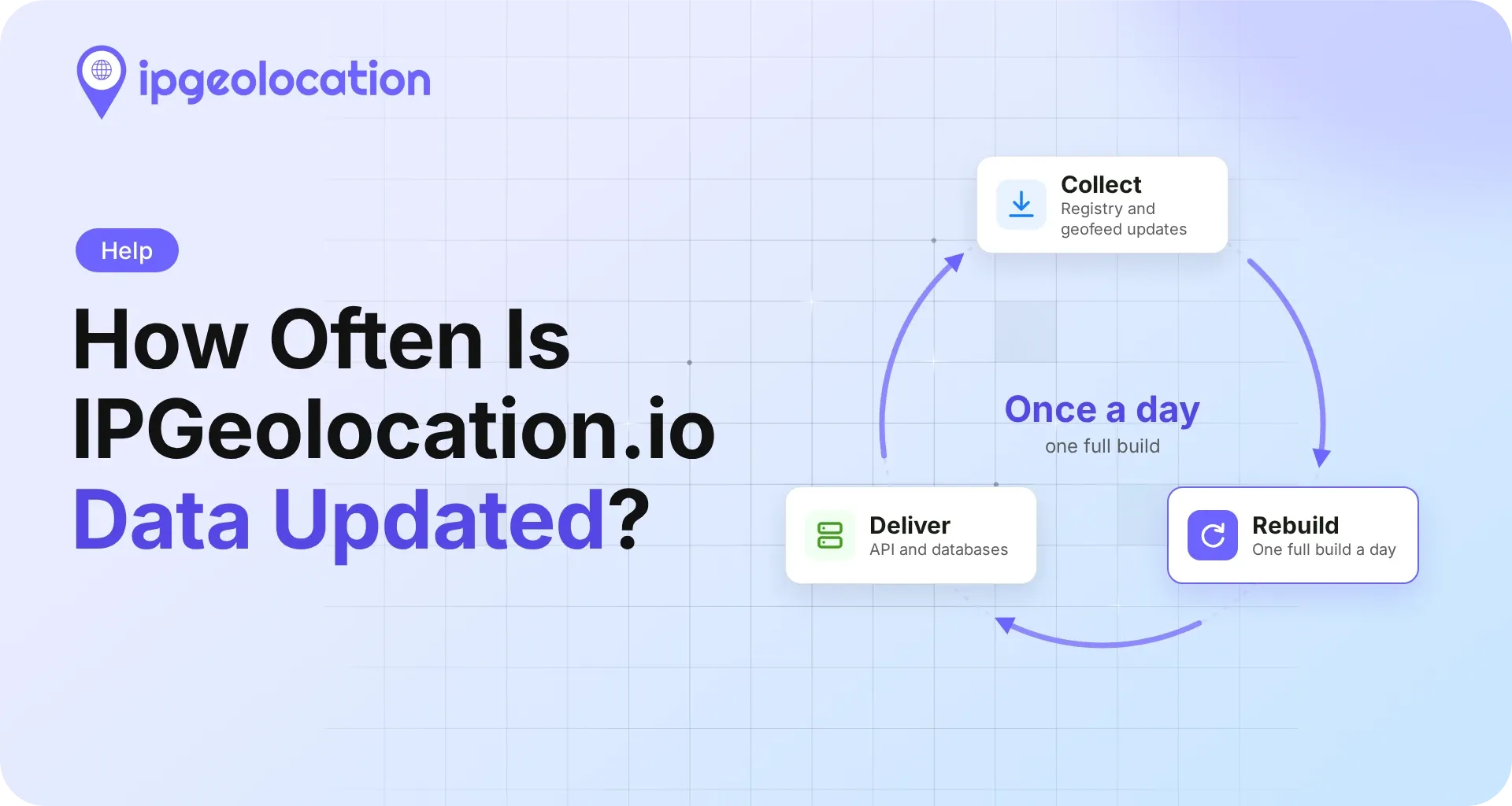
IPGeolocation.io data is updated every day. We rebuild our IP geolocation data in full once a day, as soon as every module and correction is in place, and every API request returns that latest build. Database subscribers receive the same build daily or weekly, depending on their plan.
Update schedule for each IPGeolocation.io data type
IPGeolocation.io's update frequency is the same for every data type it serves: each one comes from the same daily build. Between builds, the data stays the same for 24 hours.
That window can be too long for VPN and proxy detection, because providers sometimes rotate exit IPs between users faster than a daily build can follow. For those sessions, Real-Time Proxy & VPN Detection doesn't look the IP up in our database at all. It checks the visitor's live connection instead and usually returns a result within one to five seconds.
Which update cadence your use case needs
Pick the cadence by what a stale answer would cost you.
- Signup, login, and payment risk: the IPGeolocation.io API or a daily database, plus a real-time check of the session.
- Compliance geo-blocking: the API or a daily database. If an IP range moves into a country you block, a week-old copy still shows the old country and lets that traffic through.
- Country-level defaults such as currency, language, or content region: a weekly database is usually enough, because a stale answer here means a wrong default the visitor can change, not a missed fraud signal.
- Log enrichment and analytics: match the database cadence to how often you report. A weekly copy suits monthly dashboards; anything you alert on deserves daily data.
Why IP data keeps changing
IP data changes because addresses keep moving between users, owners, and places.
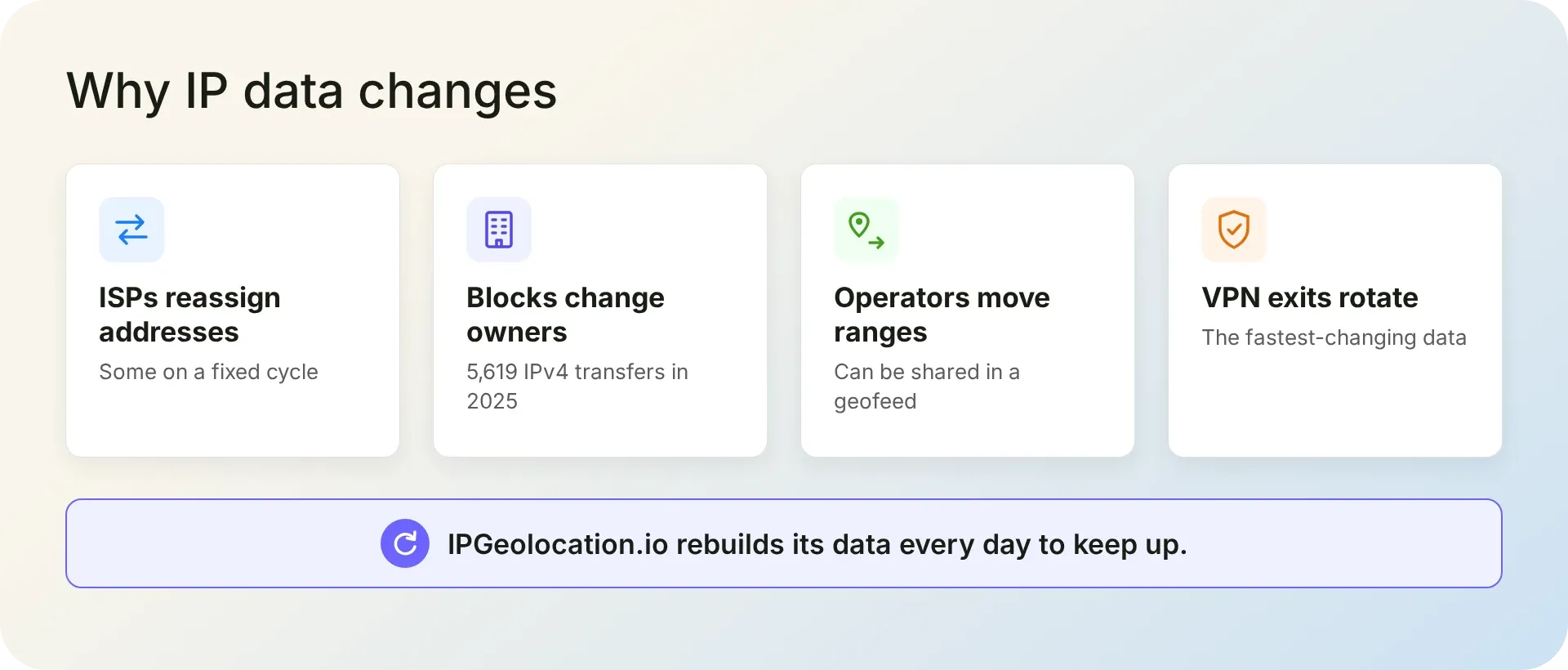
Some internet providers reassign subscribers' addresses on a fixed cycle, often a multiple of 24 hours, and addresses also tend to change after outages at the customer's router (Padmanabhan et al., 2016). An address flagged yesterday may belong to someone else today. Other networks hold steady: in one study of large US cities, most residential broadband addresses kept the same assignment for two months, though this varied by ISP (Saxon and Feamster, 2021).
Address blocks also change owners: 5,619 IPv4 transfers moved 33.4 million addresses across the five regional internet registries in 2025 (APNIC Blog). A transfer can change the company, abuse contact, and ASN behind a range, and IPGeolocation.io reflects it within 24 hours.
Operators also move ranges between cities and countries, and they can publish the change in a geofeed: a CSV file, defined in RFC 8805, that maps their IP ranges to the locations where they use them. The RFC asks readers to refresh a feed at least weekly; we fetch the roughly 10,000 geofeeds we know about (as of October 2026) every day.
Security data moves fastest, because VPN and proxy providers keep rotating exit IPs between users. Our VPN and proxy detections carry a last-seen date when one is available: vpn_last_seen is the date our crawlers last saw the IP on that VPN network, and proxy_last_seen does the same for proxies. An old date deserves less weight than a recent one.
How long does it take for IP geolocation to update?
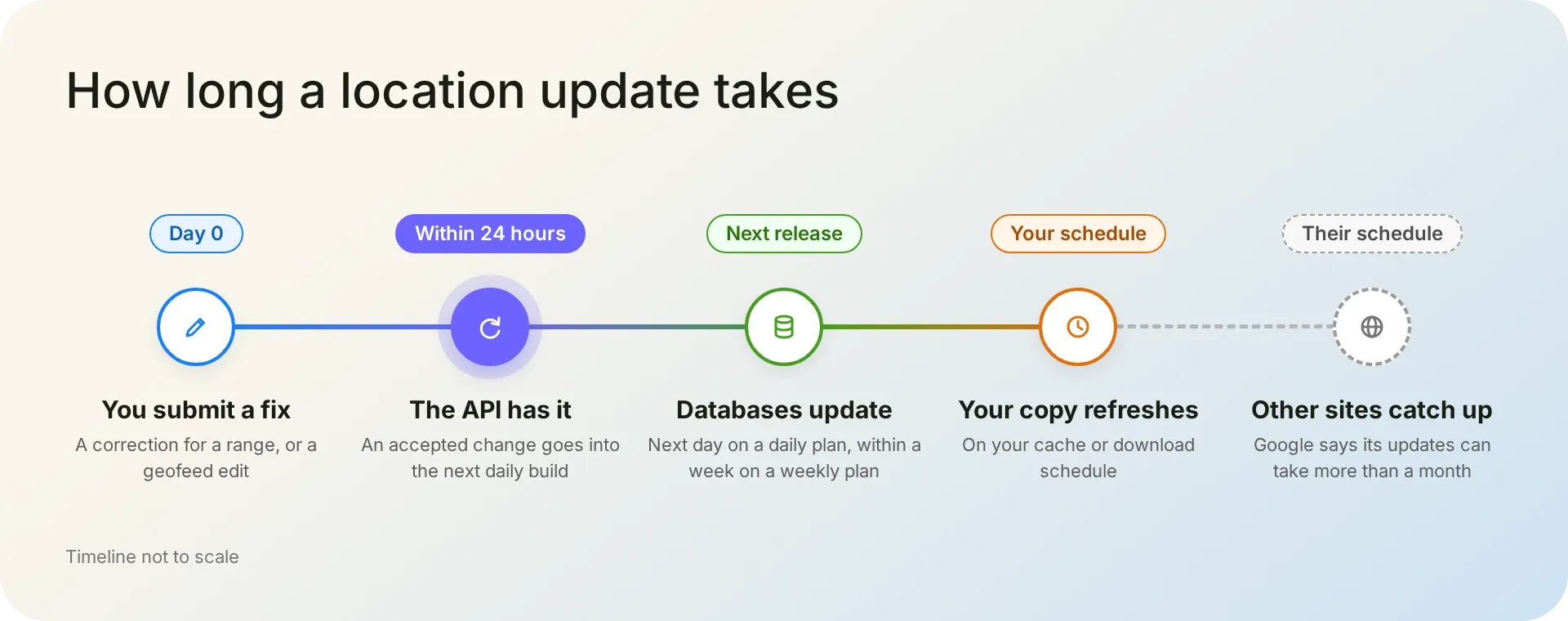
An accepted correction or geofeed change reaches the IPGeolocation.io API within 24 hours. The full path from your edit to someone else's lookup has four steps:
- You submit a correction for a range, or publish or edit your geofeed.
- We review the change, and an accepted one goes into the next daily build, which the API serves as soon as it's ready.
- Database subscribers get it in their next release: the next day on a daily plan, or within a week on a weekly plan.
- Your own cache or database copy picks it up the next time it refreshes.
If another site still shows the old location after that, it hasn't refreshed yet. Each site updates on its own schedule, and Google, for one, says its updates to IP addresses can take more than a month (Report IP problems). For a range you operate, a geofeed is the steadiest fix, because every provider that reads it picks up your next edit on its own cycle.
How to keep your copy of IPGeolocation.io data current
With the API and Snowflake, IPGeolocation.io data stays current on its own; database downloads need one check a day.
1. API lookups
If you cache API results in your app, keep each one for no more than 24 hours. Our own caches refresh as soon as a new build is ready, and the data doesn't change between builds, so a day-old cached answer is at most one build behind. For high-risk moments such as a payment or a password reset, look the IP up again instead of trusting an older cached answer.
2. Database downloads
Your subscription comes with static download links that never change: one each for the archive, its signature file, and our public key. You also get an email each time a new release is ready, as the IP Location Database (Advance) documentation describes. Our data team recommends checking the status endpoint once every 24 hours, downloading only when your database's timestamp changes, and verifying the signature on every release before it reaches production; the same documentation gives the OpenSSL command for that check.
The status endpoint, https://database.ipgeolocation.io/v2/status, needs no API key and lists a lastDailyUpdate and a lastWeeklyUpdate timestamp for each database. When the one for your database and plan changes, a new release is ready to download.
3. Snowflake shares
On Snowflake Marketplace, updates arrive automatically through data sharing.
Getting the latest IPGeolocation.io data
IPGeolocation.io data covers geolocation, security risk signals (VPN, proxy, Tor, bot, and attacker detection, with a threat score), ASN, company, and abuse contact data, with time zone data and user-agent parsing in the same API. You can query it through the IP Geolocation API or the IP Security API, download it as a database, or read it in Snowflake.
The free plan draws on the same daily build and includes 1,000 credits per day for location, ASN basics, and time zone data. Security, company, abuse contact, and user-agent data in IP lookups need a paid plan. API pricing compares the plans, and database pricing covers daily and weekly delivery.
FAQ
IPGeolocation.io rebuilds its databases every day, and subscribers receive a new release daily or weekly, depending on their plan. Each release comes with an email notice, a signature file to verify it, and a new timestamp for that database on the status endpoint.
Check IPGeolocation.io's status endpoint once every 24 hours and download only when it shows a newer timestamp for your database. Our data team recommends that schedule, along with verifying the signature on every release before it goes into production.
Use the corrections page: submit individual ranges, or share your geofeed's URL if you manage many. Accepted changes reach the IPGeolocation.io API within 24 hours, and we fetch known geofeeds daily.